

Verified NCP-CI-Azure dumps Q&As - 2024 Latest NCP-CI-Azure Download
Dumps Questions [2024] Pass for NCP-CI-Azure Exam
NEW QUESTION # 43
An administrator is planning to expand an NC2 on Azure cluster.
Which statement is true regarding prerequisites for expanding the cluster?
- A. Cluster must have at least five nodes.
- B. Cluster must have at least three nodes.
- C. Cluster must be in a Cluster Connected state.
- D. Cluster must be in a Cluster Stopped state.
Answer: C
Explanation:
* Cluster State Requirement: To expand a cluster, it must be operational and in a connected state to ensure seamless integration of additional nodes.
* Cluster Stopped State: If the cluster is stopped, it cannot perform expansion operations.
* Minimum Nodes Requirement: There is no minimum node count prerequisite for expanding the cluster as long as the cluster is connected.
* Cluster Connected State: Ensuring the cluster is connected verifies that it is operational and can communicate with additional nodes being added.
* Conclusion: The cluster must be in a Cluster Connected state to expand successfully.
References:
* Nutanix Clusters Expansion Guide
* Azure NC2 Configuration Documentation
NEW QUESTION # 44
A company wants to start using Nutanix Cloud Clusters (NC2) in Azure. The company has large spend commitments as part of a Microsoft Azure Consumption Commitment (MACC) totaling $15 million.
What approach should the administrator take to ensure the Nutanix licensing costs apply to the MACC?
- A. Purchase Nutanix licenses directly from Nutanix and contact Microsoft support.
- B. Purchase Nutanix licenses through the Azure Marketplace.
- C. Request a trial directly from Nutanix.
- D. Leverage existing Nutanix licenses
Answer: B
NEW QUESTION # 45
The cluster has the following configuration:
A Transit VPC exists as Default, but is additionally configured with a overlay-external-subnet-nonat overlay subnet The ERP for the Transit VPC is 10.1.1.0/25 A User VPC exists named User_VPC_Prod The ERP for the User VPC is 10.1.1.0/24 Outbound and inbound routes have been configured A User VM NO-NAT subnet has been configured in the User VPC The administrator has successfully created a VM and added the NIC associated with the NO-NAT subnet, but is not able to communication with other resources.
Which option will resolve this issue?
- A. Verify that the route table associated with the User VPC has appropriate routes to the Transit VPC.
- B. Ensure that the security groups associated with the VM allow traffic to and from the desired resources.
- C. Check that the network ACLs for the NO-NAT subnet are not blocking the necessary traffic.
- D. The ERP in the User VPC must be from a different CIDR range than the ERP in the transit VPC.
Answer: D
Explanation:
In this scenario, the issue arises from overlapping IP address ranges between the Transit VPC and the User VPC. Here's a detailed breakdown:
* Understanding ERPs (Elastic Routing Prefixes):
* The ERP for the Transit VPC is 10.1.1.0/25, which covers IP addresses from 10.1.1.0 to
10.1.1.127.
* The ERP for the User VPC is 10.1.1.0/24, which covers IP addresses from 10.1.1.0 to 10.1.1.255.
* IP Address Overlap:
* Since 10.1.1.0/25 is a subset of 10.1.1.0/24, there is a significant overlap in the IP address ranges of these two ERPs.
* This overlap can cause routing issues because the same IP address range is being used in both VPCs, leading to ambiguity in routing and communication.
* Communication Issue:
* When a VM in the User VPC tries to communicate with other resources, the network cannot accurately determine the correct route due to the overlapping IP address ranges.
* This overlap prevents proper routing and results in the VM being unable to communicate with other resources as intended.
* Resolution:
* To resolve this issue, the ERPs must be in different CIDR ranges. This means the IP address ranges for the Transit VPC and the User VPC should not overlap.
* For example, if the Transit VPC uses 10.1.1.0/25, the User VPC could use a different range such as 10.1.2.0/24 or any other range that does not overlap with 10.1.1.0/25.
By ensuring that the ERPs are in different CIDR ranges, the network can properly route traffic between the VPCs without any conflicts or ambiguities, thereby enabling the VM in the User VPC to communicate with other resources effectively.
NEW QUESTION # 46
An administrator is planning an NC2 deployment in Azure and wants to connect the company's on-premises datacenter to the cloud environment.
What connectivity solution should the administrator use to avoid traffic between the locations flowing over the public internet?
- A. Site-to-Site VPN
- B. ExpressRoute
- C. VTEP Gateways
- D. Point-to-Site VPN
Answer: B
Explanation:
To connect the company's on-premises datacenter to the Azure cloud environment while avoiding traffic over the public internet, the administrator should use Azure ExpressRoute. ExpressRoute provides a private connection to Azure, offering more reliability, faster speeds, and lower latencies compared to typical internet connections. This service ensures that data traffic does not traverse the public internet, enhancing security and performance.References
* Azure ExpressRoute Overview
NEW QUESTION # 47
An administrator has been tasked with ensuring NC2 VMs are able to access Azure and on-premises resources.
The NC2 VM traffic must not traverse the internet.
How can the administrator achieve this?
- A. By using an SSH connection
- B. By using ExpressRoute
- C. By using a Site-to-Site VPN
- D. By using an Interface Endpoint
Answer: B
Explanation:
* Requirement Analysis: The NC2 VMs need to access Azure and on-premises resources without traversing the internet, ensuring secure and direct connectivity.
* Solution Options:
* SSH Connection: Suitable for individual remote access, not for full VM connectivity to Azure and on-premises resources.
* Interface Endpoint: Facilitates private connectivity to specific Azure services, but not comprehensive for all resources.
* ExpressRoute: Provides private, dedicated connectivity between Azure and on-premises environments. This ensures that traffic does not traverse the public internet, meeting the security and performance requirements.
* Site-to-Site VPN: Provides secure connectivity but can involve traversing the internet, which is against the requirements.
* Conclusion: ExpressRoute is the optimal solution as it offers a private connection that does not involve internet traversal, ensuring secure and efficient access to both Azure and on-premises resources.
References:
* Azure ExpressRoute Documentation
* Nutanix Clusters on Azure Networking Guide
NEW QUESTION # 48
An organization wants to use a Jump Host to access Prism Element and Prism Central within an NC2 cluster on Azure.
Which statement is true?
- A. Jump Host instance can be deployed in the Prism Central VNet or an external VNet.
- B. Jump Host instance can only be deployed in the Prism Central VNet.
- C. Jump Host must not be used. Only VPN or ExpressRoute should be use.
- D. Jump Host instance must be deployed in the cluster VNet.
Answer: A
Explanation:
* Jump Host Deployment:A Jump Host is a secure server used to access other systems in a network. In the context of an NC2 cluster on Azure, it serves as an intermediary for accessing Prism Element and Prism Central.
* Flexible Deployment Options:The Jump Host can be deployed in either the Prism Central VNet or an external VNet, providing flexibility in network design and access strategies. This allows the organization to choose the most suitable network for deploying the Jump Host based on their security and connectivity requirements.
References:
* Nutanix NC2 on Azure Deployment Guide
* Azure Virtual Network Configuration Documentation
NEW QUESTION # 49
An on-premises network has been extended to azure with a VPN/ExpressRoute. The routing and peering of VNets is setup and has been confirmed to be correct.
Which statement best describes the state of the traffic flow between the on-prem CVMs and the NC2 CVMs in Azure?
- A. The Network Security Group of the Flow Gateway VM on the Externa! NICs will need to be edited to enable the traffic flow.
- B. The Network Security Group of the Flow Gateway VM on the Internal NICs will need to be edited to enable the traffic flow.
- C. Traffic will flow directly to the NC2 CVMs. Nothing will block the path by default.
- D. A ticket will need to be put in with Microsoft support to open the subnet ranges from on-premises.
Answer: B
Explanation:
* Network Security Groups (NSGs):NSGs control the inbound and outbound traffic to and from Azure resources. For traffic between on-premises CVMs and NC2 CVMs in Azure, the NSGs associated with the Flow Gateway VM's Internal NICs must be configured to allow the required traffic.
* Editing NSGs:To enable traffic flow, specific rules must be added to the NSGs to permit traffic from the on-premises network to the NC2 environment. Thisincludes specifying the appropriate source and destination IP ranges and the necessary ports and protocols.
References:
* Azure Network Security Groups Documentation
* Nutanix NC2 Networking Configuration Guide
NEW QUESTION # 50
Exhibit.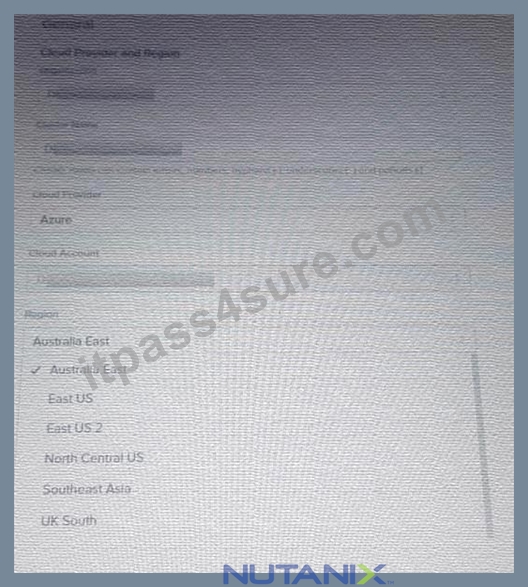
An administrator is trying to create an NC2 cluster in Azure, but does not see the required region in the drop-down list.
Which two steps could the administrator take to resolve this issue? (Choose two.)
- A. Ensure that the Azure region is whitelisted for use by Microsoft in the subscription.
- B. Check the NC2 Billingconsole to ensure the region is listed.
- C. Check the Azure subscription is created in the correct region.
- D. Check the list of regions specified under the NC2 organization cloud account.
Answer: A,D
Explanation:
* Check the list of regions specified under the NC2 organization cloud account:The list of available regions in the NC2 console might be restricted based on the configuration of the cloud account associated with the NC2 organization. Verifying this list ensures that the desired region is included and available for cluster creation.
* Ensure that the Azure region is whitelisted for use by Microsoft in the subscription:Sometimes, specific regions need to be explicitly enabled or whitelisted in the Azure subscription for certain services. This step ensures that the required region is permitted for use within the Azure subscription, allowing the NC2 cluster to be created in that region.
References:
* Azure Subscription and Service Limits Documentation
* Nutanix NC2 Configuration and Setup Guide
NEW QUESTION # 51
An administrator needs the permission to create and manage multipleorganizations and clusters in NC2, as well as manage user access for the entire company.
What role should be assigned to meet the minimum requirements of this task?
- A. Cluster Administrator
- B. Organization Administrator
- C. Customer Administrator
- D. Customer Security Administrator
Answer: C
Explanation:
* Role Requirements: The task involves creating and managing multiple organizations and clusters, along with managing user access across the company.
* Role Capabilities: The "Customer Administrator" role is designed to provide extensive administrative capabilities, including:
* Creating and managing organizations.
* Managing clusters.
* Handling user access and permissions.
* Comparison of Roles:
* Cluster Administrator: Primarily focuses on managing individual clusters but does not encompass organization-wide administrative tasks.
* Customer Security Administrator: Focuses on security-related tasks and does not have broad administrative capabilities across organizations and clusters.
* Organization Administrator: Manages organizational settings but might not cover all aspects needed for multiple clusters and user access management.
* Conclusion: The "Customer Administrator" role meets all the requirements for managing organizations, clusters, and user access comprehensively.
References:
* Nutanix Role-Based Access Control Documentation
* NC2 on Azure User Roles Guide
NEW QUESTION # 52
An administrator needs to open the following ports in the firewall between an on-premises cluster and azure for disaster recovery:
* 22
* 2009
* 2020
* 2049
* 3260
* 9440
Which rile-type should be created on the firewall for communication to be appropriately established?
- A. Bi-directional (ICMP)
- B. Outbound (TCP)
- C. Bi-directional (TCP)
- D. Outbound (ICMP)
Answer: C
Explanation:
* Port Requirements: The specified ports (22, 2009, 2020, 2049, 3260, 9440) are commonly used for various services and require TCP communication.
* Port 22: SSH
* Port 2009: Used for Nutanix internal communication
* Port 2020: Nutanix services
* Port 2049: NFS
* Port 3260: iSCSI
* Port 9440: Nutanix Prism management
* Communication Type: To ensure proper disaster recovery setup, bi-directional communication is needed to allow traffic to flow both from on-premises to Azure and vice versa.
* TCP Protocol: These ports use the TCP protocol, which provides reliable communication between devices.
* Conclusion: Creating a bi-directional (TCP) rule on the firewall allows the necessary communication for disaster recovery processes.
References:
* Nutanix Networking and Security Documentation
* Azure Networking Documentation
NEW QUESTION # 53
An administrator needs to attach a network interface to a Flow Gateway VM.
What option should be enabled in the Azure portal and in the OS of the Flow gateway VM to meet this network requirement?
- A. Port Tagging
- B. IP Forwarding
- C. Dynamic Route
- D. Static Route
Answer: B
Explanation:
* IP Forwarding in Azure:Enabling IP forwarding allows the VM to forward network traffic that is not specifically addressed to itself. This is necessary for network devices like the Flow Gateway VM to route traffic correctly.
* Network Interface Configuration:Both the Azure portal settings and the VM's operating system must
* have IP forwarding enabled to ensure proper traffic handling and routing capabilities.
References:
* Azure Virtual Machine Networking Documentation
* Nutanix Flow Gateway Configuration Guide
NEW QUESTION # 54
A company is extending asubnet from their on-premises environment to an NC2cluster on Azure. The company is considering using either a Virtual Tunnel End Point (VTEP) or a layer 2 subnet Extension over VPN.
In which two scenarios would it be advantageous to use VTEP for this requirement? (Choose two.)
- A. Multiple remote Availability Zones exist to add to the same VTEP-based extended Layer 2 subnet.
- B. Connectivity between sites already provides encryption.
- C. Only one remote Availability Zone exists that needs the subnet extended.
- D. Connectivity between sites already does not provided encryption.
Answer: A,B
Explanation:
* Scenario Analysis:
* A. Connectivity between sites already provides encryption: Using VTEP in this scenario is advantageous because VTEP does not inherently provide encryption. If encryption is already provided, VTEP can be effectively used without additional security concerns.
* D. Multiple remote Availability Zones exist to add to the same VTEP-based extended Layer 2 subnet: VTEP is well-suited for scenarios where multiple remote Availability Zones need to be connected to the same extended Layer 2 subnet. This allows for efficient management and seamless connectivity across different zones.
* Scenarios B and C:
* B. Only one remote Availability Zone exists that needs the subnet extended: This scenario does
* not leverage the strengths of VTEP, as it is better suited for multiple zones.
* C. Connectivity between sites already does not provide encryption: Using VTEP without existing encryption is not ideal as VTEP itself does not encrypt the traffic.
* Conclusion: VTEP is advantageous when encryption is already in place and when multiple remote zones need to be connected to the same extended subnet.
References:
* Nutanix NC2 Networking Guide
* Azure Networking Documentation
NEW QUESTION # 55
What is an available log module when configuring a syslog server in the Prism Central Admin Center?
- A. Prism
- B. Zookeeper
- C. Acropolis
- D. API Audit
Answer: C
Explanation:
* Log Modules in Prism Central:When configuring a syslog server, different log modules can be selected to send logs to an external syslog server for centralized logging and analysis.
* Acropolis Logs:The Acropolis module captures logs related to the Acropolis Hypervisor (AHV), including virtual machine operations, storage operations, and other critical functions within the Nutanix environment.
References:
* Nutanix Prism Central Administration Guide
* Nutanix Acropolis Documentation
NEW QUESTION # 56
When selecting the NC2 subscription plan from the Nutanix billing portal, which options are available?
- A. Reserved instances, Cloud Provider Credits, Bring your own License (BYOL)
- B. Reserved instances, Bring your own License (BYOL)
- C. Pay-as-you-Go (PayG), Cloud Provider Credits, Bring you own License (BYOL)
- D. Pay-as-you-Go (payG), Bring your own License (BYOL)
Answer: D
Explanation:
When selecting the NC2 subscription plan from the Nutanix billing portal, the available options are:
* Pay-as-you-Go (PayG):Allows you to pay for the services as you use them, providing flexibility and avoiding upfront costs.
* Bring your own License (BYOL):Enables you to use your existing Nutanix licenses within the cloud environment, offering cost savings if you already have licenses.
These options provide flexibility in how you can manage and pay for your Nutanix cloud clusters.References
* Nutanix Cloud Clusters Pricing and Plans
NEW QUESTION # 57
A new subnet needs to be created within Flow Virtual Networking to accommodate a new type of workload in the company's NC2 Azure instance.
Which type of network will satisfy this task?
- A. VNET
- B. Overlay
- C. Underlay
- D. VPC
Answer: B
Explanation:
* Flow Virtual Networking: Nutanix Flow Virtual Networking allows for the creation of overlay networks to segment and manage network traffic.
* Network Types:
* Underlay: Refers to the physical network infrastructure.
* Overlay: Logical network built on top of the physical infrastructure, providing flexibility for creating isolated subnets and accommodating different workloads.
* VPC: Virtual Private Cloud, a network within a public cloud provider.
* VNET: Azure-specific virtual network.
* Requirement: Creating a subnet for new workloads within Flow Virtual Networking suggests using an overlay network for logical separation and management.
* Conclusion: An overlay network within Flow Virtual Networking will satisfy the task of accommodating a new type of workload in the NC2 Azure instance.
References:
* Nutanix Flow Networking Guide
* Azure Virtual Network Documentation
NEW QUESTION # 58
......
Updated Nutanix Study Guide NCP-CI-Azure Dumps Questions: https://www.itpass4sure.com/NCP-CI-Azure-practice-exam.html
Valid NCP-CI-Azure exam with Nutanix Real Exam Questions: https://drive.google.com/open?id=1nQV-3qz2V__H_noUUVEc6Otjqs3dLvwD
