

Prepare for the Actual Cloud DevOps Engineer Professional-Cloud-DevOps-Engineer Exam Practice Materials Collection
Cloud DevOps Engineer Certified Official Practice Test Professional-Cloud-DevOps-Engineer - Mar-2024
Earning the Google Professional-Cloud-DevOps-Engineer certification demonstrates that the candidate has the skills and knowledge required to design and manage efficient cloud-based systems using Google Cloud technologies. Google Cloud Certified - Professional Cloud DevOps Engineer Exam certification is recognized globally and is highly valued by employers who are looking for professionals with expertise in DevOps and cloud-based systems management. It also provides the candidate with an opportunity to enhance their career prospects and expand their professional network in the cloud computing industry.
The Google Professional-Cloud-DevOps-Engineer exam is designed to evaluate the candidate's ability to design and implement DevOps processes and practices using the Google Cloud Platform. This includes skills such as developing and managing continuous integration and delivery pipelines, configuring monitoring and alerting strategies, implementing automated testing frameworks, and managing infrastructure as code.
Topics of Google Professional Cloud DevOps Engineer Exam
Candidates must know the exam topics before they start preparation because it will help them in hitting the core. Our Professional Cloud DevOps Engineer Dumps will include the following topics:
Applying site reliability engineering principles to a service
- Construct feedback loops to decide what to build next
- 1.2 Manage service life cycle:
- Balance change, velocity, and reliability of the service:
- Discover SLIs (availability, latency, etc.)
- Define SLOs and understand SLAs
- Agree to consequences of not meeting the error budget
Building and implementing CI/CD pipelines for a service
- Deployment to hybrid and multi-cloud environments with Anthos, Spinnaker, Kubernetes
- CI/CD pipeline triggers with Cloud Source Repositories, Cloud Build GitHub App, Cloud Pub/Sub
- Deployment strategies with Cloud Build, Spinnaker
- Design CI/CD pipelines:
- Artifact versioning strategy with Cloud Build, Container Registry
Implementing service monitoring strategies
- Set ACL to restrict export configuration with IAM, Stackdriver Logging
- Set ACL to allow metric writing for custom metrics with IAM, Stackdriver Monitoring
- Enabling VPC flow logs
- Using basic vs. advanced logging filters
- Collecting logs from Compute Engine, GKE with Stackdriver Logging, Fluentd
- Understanding the logging exclusion vs. logging export
- Sending logs to an external logging platform
- Collecting metrics from Compute Engine
- Manage application logs:
- Use metric explorer for ad hoc metric analysis
- Implementing logs-based metrics
- Collecting GKE/Kubernetes metrics
- Implementing a project-level / org-level export
- Selecting the options for logging export
- Viewing logs in the GCP Console
- Collecting third-party and structured logs with Stackdriver Logging, Fluentd
- Enabling data access logs (e.g., Cloud Audit Logs)
Optimizing service performance
- Troubleshoot issues with the image/OS
- Consider network pricing
- Identify service performance issues:
- Develop a plan to optimize areas of greatest cost or lowest utilization
- TCO considerations
- Manage preemptible VMs
- Identify resource utilization levels
Managing service incidents
- Avoid exhaustion/burnout
- Identify probable causes of service failure
- Rotate/hand over roles
- Evaluate symptoms against probable causes; the rank probability of cause based on observed behavior
- Define roles (incident commander, communication lead, operations lead)
- Scaling response team and delegation
- Manage stakeholder relationships
- Record major changes in incident state (When mitigated? When all clear? etc.)
NEW QUESTION # 82
You are running an experiment to see whether your users like a new feature of a web application. Shortly after deploying the feature as a canary release, you receive a spike in the number of 500 errors sent to users, and your monitoring reports show increased latency. You want to quickly minimize the negative impact on users. What should you do first?
- A. Trace the origin of 500 errors and the root cause of increased latency.
- B. Roll back the experimental canary release.
- C. Start monitoring latency, traffic, errors, and saturation.
- D. Record data for the postmortem document of the incident.
Answer: A
NEW QUESTION # 83
You manage several production systems that run on Compute Engine in the same Google Cloud Platform (GCP) project. Each system has its own set of dedicated Compute Engine instances. You want to know how must it costs to run each of the systems. What should you do?
- A. In the Google Cloud Platform Console, use the Cost Breakdown section to visualize the costs per system.
- B. Enrich all instances with metadata specific to the system they run. Configure Stackdriver Logging to export to BigQuery, and query costs based on the metadata.
- C. Assign all instances a label specific to the system they run. Configure BigQuery billing export and query costs per label.
- D. Name each virtual machine (VM) after the system it runs. Set up a usage report export to a Cloud Storage bucket. Configure the bucket as a source in BigQuery to query costs based on VM name.
Answer: C
Explanation:
https://cloud.google.com/billing/docs/how-to/export-data-bigquery
NEW QUESTION # 84
You support an application running on App Engine. The application is used globally and accessed from various device types. You want to know the number of connections. You are using Stackdriver Monitoring for App Engine. What metric should you use?
- A. tcp_ssl_proxy/new_connections
- B. flex/instance/connections/current
- C. tcp_ssl_proxy/open_connections
- D. flex/connections/current
Answer: D
Explanation:
Explanation
https://cloud.google.com/monitoring/api/metrics_gcp#gcp-appengine
NEW QUESTION # 85
You support a high-traffic web application and want to ensure that the home page loads in a timely manner. As a first step, you decide to implement a Service Level Indicator (SLI) to represent home page request latency with an acceptable page load time set to 100 ms. What is the Google-recommended way of calculating this SLI?
- A. Buckelize Ihe request latencies into ranges, and then compute the percentile at 100 ms.
- B. Count the number of home page requests that load in under 100 ms. and then divide by the total number of all web application requests.
- C. Bucketize the request latencies into ranges, and then compute the median and 90th percentiles.
- D. Count the number of home page requests that load in under 100 ms, and then divide by the total number of home page requests.
Answer: D
Explanation:
Explanation
https://sre.google/workbook/implementing-slos/
In the SRE principles book, it's recommended treating the SLI as the ratio of two numbers: the number of good events divided by the total number of events. For example: Number of successful HTTP requests / total HTTP requests (success rate)
NEW QUESTION # 86
Your team of Infrastructure DevOps Engineers is growing, and you are starting to use Terraform to manage infrastructure. You need a way to implement code versioning and to share code with other team members. What should you do?
- A. Store the Terraform code in a version-control system. Establish procedures for pushing new versions and merging with the master.
- B. Store the Terraform code in a Cloud Storage bucket using object versioning. Give access to the bucket to every team member so they can download the files.
- C. Store the Terraform code in a network shared folder with child folders for each version release. Ensure that everyone works on different files.
- D. Store the Terraform code in a shared Google Drive folder so it syncs automatically to every team member's computer. Organize files with a naming convention that identifies each new version.
Answer: A
Explanation:
https://www.terraform.io/docs/cloud/guides/recommended-practices/part3.3.html
NEW QUESTION # 87
You are implementing a CI'CD pipeline for your application in your company s multi-cloud environment Your application is deployed by using custom Compute Engine images and the equivalent in other cloud providers You need to implement a solution that will enable you to build and deploy the images to your current environment and is adaptable to future changes Which solution stack should you use'?
- A. Cloud Build with Packer
- B. Cloud Build with kpt
- C. Cloud Build with Google Cloud Deploy
- D. Google Kubernetes Engine with Google Cloud Deploy
Answer: C
Explanation:
Cloud Build is a fully managed continuous integration and continuous delivery (CI/CD) service that helps you automate your builds, tests, and deployments. Google Cloud Deploy is a service that automates the deployment of your applications to Google Kubernetes Engine (GKE).
Together, Cloud Build and Google Cloud Deploy can be used to build and deploy your application's custom Compute Engine images to your current environment and to other cloud providers in the future.
Here are the steps involved in using Cloud Build and Google Cloud Deploy to implement a CI/CD pipeline for your application:
Create a Cloud Build trigger that fires whenever a change is made to your application's code.
In the Cloud Build trigger, configure Cloud Build to build your application's Docker image.
Create a Google Cloud Deploy configuration file that specifies how to deploy your application's Docker image to GKE.
In Google Cloud Deploy, create a deployment that uses your configuration file.
Once you have created the Cloud Build trigger and Google Cloud Deploy configuration file, any changes made to your application's code will trigger Cloud Build to build a new Docker image. Google Cloud Deploy will then deploy the new Docker image to GKE.
This solution stack is adaptable to future changes because it uses a cloud-agnostic approach. Cloud Build can be used to build Docker images for any cloud provider, and Google Cloud Deploy can be used to deploy Docker images to any Kubernetes cluster.
The other solution stacks are not as adaptable to future changes. For example, solution stack A (Cloud Build with Packer) is limited to building Docker images for Compute Engine. Solution stack C (Google Kubernetes Engine with Google Cloud Deploy) is limited to deploying Docker images to GKE. Solution stack D (Cloud Build with kpt) is a newer solution that is not yet as mature as Cloud Build and Google Cloud Deploy.
Overall, the best solution stack for implementing a CI/CD pipeline for your application in a multi-cloud environment is Cloud Build with Google Cloud Deploy. This solution stack is fully managed, cloud-agnostic, and adaptable to future changes.
NEW QUESTION # 88
Your applications performance in Google Cloud has degraded since the last release You suspect that downstream dependencies might be causing some requests to take longer to complete You need to investigate the issue with your application to determine the cause What should you do?
- A. Configure Error Reporting in your application
- B. Configure Google Cloud Managed Service for Prometheus in your application
- C. Configure Cloud Trace in your application
- D. Configure Cloud Profiler in your application
Answer: C
Explanation:
The best option for investigating the issue with your application's performance in Google Cloud is to configure Cloud Trace in your application. Cloud Trace is a service that allows you to collect and analyze latency data from your application. You can use Cloud Trace to trace requests across different components of your application, such as downstream dependencies, and identify where they take longer to complete. You can also use Cloud Trace to compare latency data across different versions of your application, and detect any performance degradation or improvement. By using Cloud Trace, you can diagnose and troubleshoot performance issues with your application in Google Cloud.
NEW QUESTION # 89
You need to run a business-critical workload on a fixed set of Compute Engine instances for several months. The workload is stable with the exact amount of resources allocated to it. You want to lower the costs for this workload without any performance implications. What should you do?
- A. Migrate the instances to a Managed Instance Group.
- B. Create an Unmanaged Instance Group for the instances used to run the workload.
- C. Purchase Committed Use Discounts.
- D. Convert the instances to preemptible virtual machines.
Answer: C
NEW QUESTION # 90
You need to define SLOs for a high-traffic web application. Customers are currently happy with the application performance and availability. Based on current measurement, the 90th percentile Of latency is 160 ms and the 95th percentile of latency is 300 ms over a 28-day window. What latency SLO should you publish?
- A. 90th percentile - 150 ms
95th percentile - 290 ms - B. 90th percentile - 300 ms
95th percentile - 450 ms - C. 90th percentile - 160 ms
95th percentile - 300 ms - D. 90th percentile - 190 ms
95th percentile - 330 ms
Answer: C
Explanation:
a latency SLO is a service level objective that specifies a target level of responsiveness for a web application1. A latency SLO can be expressed as a percentile of latency over a time window, such as the 90th percentile of latency over 28 days2. A percentile of latency is the maximum amount of time that a given percentage of requests take to complete. For example, the 90th percentile of latency is the maximum amount of time that 90% of requests take to complete3.
To define a latency SLO, you need to consider the following factors24:
The expectations and satisfaction of your customers. You want to set a latency SLO that reflects the level of performance that your customers are happy with and willing to pay for.
The current and historical measurements of your latency. You want to set a latency SLO that is based on data and realistic for your web application.
The trade-offs and costs of improving your latency. You want to set a latency SLO that balances the benefits of faster response times with the costs of engineering work, infrastructure, and complexity.
Based on these factors, the best option for defining a latency SLO for your web application is option B. Option B sets the latency SLO to match the current measurement of your latency, which means that you are meeting the expectations and satisfaction of your customers. Option B also sets a realistic and achievable target for your web application, which means that you do not need to invest extra resources or effort to improve your latency. Option B also aligns with the best practice of setting conservative SLOs, which means that you have some buffer or margin for error in case your latency fluctuates or degrades5.
NEW QUESTION # 91
You are developing a strategy for monitoring your Google Cloud Platform (GCP) projects in production using Stackdriver Workspaces. One of the requirements is to be able to quickly identify and react to production environment issues without false alerts from development and staging projects. You want to ensure that you adhere to the principle of least privilege when providing relevant team members with access to Stackdriver Workspaces. What should you do?
- A. Grant relevant team members the Project Viewer IAM role on all GCP production projects. Create Slackdriver workspaces inside each project.
- B. Create a new GCP monitoring project, and create a Stackdriver Workspace inside it. Attach the production projects to this workspace. Grant relevant team members read access to the Stackdriver Workspace.
- C. Choose an existing GCP production project to host the monitoring workspace. Attach the production projects to this workspace. Grant relevant team members read access to the Stackdriver Workspace.
- D. Grant relevant team members read access to all GCP production projects. Create Stackdriver workspaces inside each project.
Answer: B
Explanation:
"A Project can host many Projects and appear in many Projects, but it can only be used as the scoping project once. We recommend that you create a new Project for the purpose of having multiple Projects in the same scope."
NEW QUESTION # 92
You support the backend of a mobile phone game that runs on a Google Kubernetes Engine (GKE) cluster. The application is serving HTTP requests from users. You need to implement a solution that will reduce the network cost. What should you do?
- A. Configure the VPC as a Shared VPC Host project.
- B. Configure your Kubernetes duster as a Private Cluster.
- C. Configure a Google Cloud HTTP Load Balancer as Ingress.
- D. Configure your network services on the Standard Tier.
Answer: C
Explanation:
Costs associated with a load balancer are charged to the project containing the load balancer components. Because of these benefits, container-native load balancing is the recommended solution for load balancing through Ingress. When NEGs are used with GKE Ingress, the Ingress controller facilitates the creation of all aspects of the L7 load balancer. This includes creating the virtual IP address, forwarding rules, health checks, firewall rules, and more. https://cloud.google.com/architecture/best-practices-for-running-cost-effective-kubernetes-applications-on-gke
NEW QUESTION # 93
Your application images are built using Cloud Build and pushed to Google Container Registry (GCR). You want to be able to specify a particular version of your application for deployment based on the release version tagged in source control. What should you do when you push the image?
- A. Reference the image digest in the source control tag.
- B. Supply the source control tag as a parameter within the image name.
- C. Use GCR digest versioning to match the image to the tag in source control.
- D. Use Cloud Build to include the release version tag in the application image.
Answer: B
Explanation:
Explanation
https://cloud.google.com/container-registry/docs/pushing-and-pulling
NEW QUESTION # 94
Your Cloud Run application writes unstructured logs as text strings to Cloud Logging. You want to convert the unstructured logs to JSON-based structured logs. What should you do?
- A. Modify the application to use Cloud Logging software development kit (SDK), and send log entries with a jsonPay10ad field.
- B. Install the log agent in the Cloud Run container image, and use the log agent to forward logs to Cloud Logging.
- C. A Install a Fluent Bit sidecar container, and use a JSON parser.
- D. Configure the log agent to convert log text payload to JSON payload.
Answer: A
Explanation:
Explanation
The correct answer is D. Modify the application to use Cloud Logging software development kit (SDK), and send log entries with a jsonPayload field.
Cloud Logging SDKs are libraries that allow you to write structured logs from your Cloud Run application.
You can use the SDKs to create log entries with a jsonPayload field, which contains a JSON object with the properties of your log entry. The jsonPayload field allows you to use advanced features of Cloud Logging, such as filtering, querying, and exporting logs based on the properties of your log entry1.
To use Cloud Logging SDKs, you need to install the SDK for your programming language, and then use the SDK methods to create and send log entries to Cloud Logging. For example, if you are using Node.js, you can use the following code to write a structured log entry with a jsonPayload field2:
// Imports the Google Cloud client library
const {Logging} = require('@google-cloud/logging');
// Creates a client
const logging = new Logging();
// Selects the log to write to
const log = logging.log('my-log');
// The data to write to the log
const text = 'Hello, world!';
const metadata = {
// Set the Cloud Run service name and revision as labels
labels: {
service_name: process.env.K_SERVICE || 'unknown',
revision_name: process.env.K_REVISION || 'unknown',
},
// Set the log entry payload type and value
jsonPayload: {
message: text,
timestamp: new Date(),
},
};
// Prepares a log entry
const entry = log.entry(metadata);
// Writes the log entry
await log.write(entry);
console.log(`Logged: ${text}`);
Using Cloud Logging SDKs is the best way to convert unstructured logs to structured logs, as it provides more flexibility and control over the format and content of your log entries.
Using a Fluent Bit sidecar container is not a good option, as it adds complexity and overhead to your Cloud Run application. Fluent Bit is a lightweight log processor and forwarder that can be used to collect and parse logs from various sources and send them to different destinations3. However, Cloud Run does not support sidecar containers, so you would need to run Fluent Bit as part of your main container image. This would require modifying your Dockerfile and configuring Fluent Bit to read logs from supported locations and parse them as JSON. This is more cumbersome and less reliable than using Cloud Logging SDKs.
Using the log agent in the Cloud Run container image is not possible, as the log agent is not supported on Cloud Run. The log agent is a service that runs on Compute Engine or Google Kubernetes Engine instances and collects logs from various applications and system components. However, Cloud Run does not allow you to install or run any agents on its underlying infrastructure, as it is a fully managed service that abstracts away the details of the underlying platform.
Storing the password directly in the code is not a good practice, as it exposes sensitive information and makes it hard to change or rotate the password. It also requires rebuilding and redeploying the application each time the password changes, which adds unnecessary work and downtime.
References:
1: Writing structured logs | Cloud Run Documentation | Google Cloud
2: Write structured logs | Cloud Run Documentation | Google Cloud
3: Fluent Bit - Fast and Lightweight Log Processor & Forwarder
Logging Best Practices for Serverless Applications - Google Codelabs
About the logging agent | Cloud Logging Documentation | Google Cloud
Cloud Run FAQ | Google Cloud
NEW QUESTION # 95
A third-party application needs to have a service account key to work properly When you try to export the key from your cloud project you receive an error "The organization policy constraint larn.disableServiceAccountKeyCreation is enforcedM You need to make the third-party application work while following Google-recommended security practices What should you do?
- A. Enable the default service account key. and download the key
- B. Add a rule to set the iam.disableServiceAccountKeyCreation policy to off in your project and create a key.
- C. Disable the service account key creation policy at the project's folder, and download the default key
- D. Remove the iam.disableServiceAccountKeyCreation policy at the organization level, and create a key.
Answer: B
Explanation:
The best option for making the third-party application work while following Google-recommended security practices is to add a rule to set the iam.disableServiceAccountKeyCreation policy to off in your project and create a key. The iam.disableServiceAccountKeyCreation policy is an organization policy that controls whether service account keys can be created in a project or organization. By default, this policy is set to on, which means that service account keys cannot be created. However, you can override this policy at a lower level, such as a project, by adding a rule to set it to off. This way, you can create a service account key for your project without affecting other projects or organizations. You should also follow the best practices for managing service account keys, such as rotating them regularly, storing them securely, and deleting them when they are no longer needed.
NEW QUESTION # 96
You support a web application that runs on App Engine and uses CloudSQL and Cloud Storage for data storage. After a short spike in website traffic, you notice a big increase in latency for all user requests, increase in CPU use, and the number of processes running the application. Initial troubleshooting reveals:
After the initial spike in traffic, load levels returned to normal but users still experience high latency.
Requests for content from the CloudSQL database and images from Cloud Storage show the same high latency.
No changes were made to the website around the time the latency increased.
There is no increase in the number of errors to the users.
You expect another spike in website traffic in the coming days and want to make sure users don't experience latency. What should you do?
- A. Move the application from App Engine to Compute Engine.
- B. Modify the App Engine configuration to have additional idle instances.
- C. Enable high availability on the CloudSQL instances.
- D. Upgrade the GCS buckets to Multi-Regional.
Answer: B
Explanation:
Scaling App Engine scales the number of instances automatically in response to processing volume. This scaling factors in the automatic_scaling settings that are provided on a per-version basis in the configuration file. A service with basic scaling is configured by setting the maximum number of instances in the max_instances parameter of the basic_scaling setting. The number of live instances scales with the processing volume. You configure the number of instances of each version in that service's configuration file. The number of instances usually corresponds to the size of a dataset being held in memory or the desired throughput for offline work. You can adjust the number of instances of a manually-scaled version very quickly, without stopping instances that are currently running, using the Modules API set_num_instances function. https://cloud.google.com/appengine/docs/standard/python/how-instances-are-managed
https://cloud.google.com/appengine/docs/standard/python/config/appref
max_idle_instances Optional. The maximum number of idle instances that App Engine should maintain for this version. Specify a value from 1 to 1000. If not specified, the default value is automatic, which means App Engine will manage the number of idle instances. Keep the following in mind: A high maximum reduces the number of idle instances more gradually when load levels return to normal after a spike. This helps your application maintain steady performance through fluctuations in request load, but also raises the number of idle instances (and consequent running costs) during such periods of heavy load.
NEW QUESTION # 97
You are leading a DevOps project for your organization. The DevOps team is responsible for managing the service infrastructure and being on-call for incidents. The Software Development team is responsible for writing, submitting, and reviewing code. Neither team has any published SLOs. You want to design a new joint-ownership model for a service between the DevOps team and the Software Development team. Which responsibilities should be assigned to each team in the new joint-ownership model?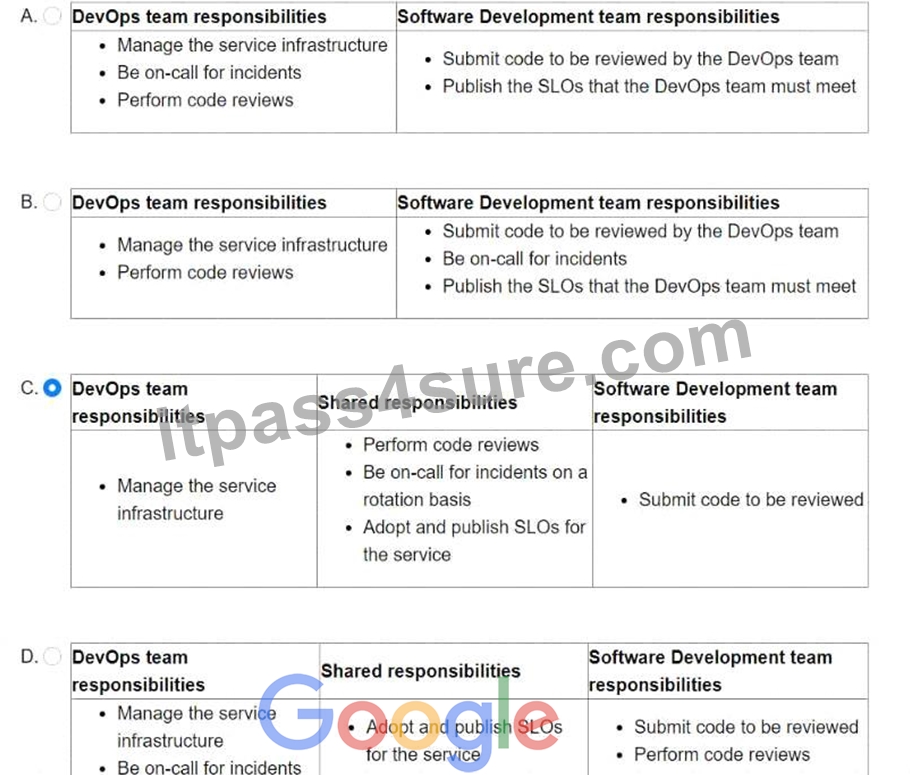
- A. Option B
- B. Option A
- C. Option C
- D. Option D
Answer: D
Explanation:
Explanation
The correct answer is D. Option D.
According to the DevOps best practices, a joint-ownership model for a service between the DevOps team and the Software Development team should follow these principles12:
The DevOps team and the Software Development team should share the responsibility and collaboration for managing the service infrastructure, performing code reviews, and adopting and sharing SLOs for the service.
The DevOps team and the Software Development team should have end-to-end ownership of the service, from design to development to deployment to operation to maintenance.
The DevOps team and the Software Development team should use common tools and processes to facilitate communication, coordination, and feedback.
The DevOps team and the Software Development team should align their goals and incentives with the business outcomes and customer satisfaction.
Option D is the only option that reflects these principles. Option D assigns both teams the responsibilities of managing the service infrastructure, performing code reviews, and adopting and sharing SLOs for the service.
Option D also implies that both teams have end-to-end ownership of the service, as they are involved in every stage of the service lifecycle. Option D also encourages both teams to use common tools and processes, such as GitLab3, to collaborate and communicate effectively. Option D also aligns both teams with the business outcomes and customer satisfaction, as they use SLOs to measure and improve the service quality.
The other options are incorrect because they do not follow the DevOps best practices. Option A is incorrect because it assigns only the DevOps team the responsibility of managing the service infrastructure, which creates a silo between the two teams and reduces their collaboration. Option A also does not assign any responsibility for adopting and sharing SLOs for the service, which means that both teams lack a common metric for measuring and improving the service quality. Option B is incorrect because it assigns only the Software Development team the responsibility of performing code reviews, which creates a gap between the two teams and reduces their feedback. Option B also does not assign any responsibility for adopting and sharing SLOs for the service, which means that both teams lack a common metric for measuring and improving the service quality. Option C is incorrect because it assigns both teams the same responsibilities as option A and option B, which combines their drawbacks.
NEW QUESTION # 98
You have a CI/CD pipeline that uses Cloud Build to build new Docker images and push them to Docker Hub. You use Git for code versioning. After making a change in the Cloud Build YAML configuration, you notice that no new artifacts are being built by the pipeline. You need to resolve the issue following Site Reliability Engineering practices. What should you do?
- A. Change the CI pipeline to push the artifacts to Container Registry instead of Docker Hub.
- B. Run a Git compare between the previous and current Cloud Build Configuration files to find and fix the bug.
- C. Disable the CI pipeline and revert to manually building and pushing the artifacts.
- D. Upload the configuration YAML file to Cloud Storage and use Error Reporting to identify and fix the issue.
Answer: C
NEW QUESTION # 99
Your company runs services by using Google Kubernetes Engine (GKE). The GKE clusters in the development environment run applications with verbose logging enabled. Developers view logs by using the kubect1 logs command and do not use Cloud Logging. Applications do not have a uniform logging structure defined. You need to minimize the costs associated with application logging while still collecting GKE operational logs.
What should you do?
- A. Run the gcloud container clusters update logging=WORKLOAD command for the development cluster.
- B. Add the severity >= DEBUG resource. type "k83 container" exclusion filter to the Default logging sink in the project associated with the development environment.
- C. Run the gcloud logging sinks update _Defau1t --disabled command in the project associated with the development environment.
- D. Run the gcloud container clusters update --logging-SYSTEM command for the development cluster.
Answer: D
NEW QUESTION # 100
You manage an application that runs in Google Kubernetes Engine (GKE) and uses the blue/green deployment methodology Extracts of the Kubernetes manifests are shown below
The Deployment app-green was updated to use the new version of the application During post-deployment monitoring you notice that the majority of user requests are failing You did not observe this behavior in the testing environment You need to mitigate the incident impact on users and enable the developers to troubleshoot the issue What should you do?
- A. Update the Deployment ape-green to use the previous version of the application
- B. Change the selector on the Service app-2vc to app: my-app.
- C. Update the Deployment app-blue to use the new version of the application
- D. Change the selector on the Service app-svc to app: my-app, version: blue
Answer: D
Explanation:
The best option for mitigating the incident impact on users and enabling the developers to troubleshoot the issue is to change the selector on the Service app-svc to app: my-app, version: blue. A Service is a resource that defines how to access a set of Pods. A selector is a field that specifies which Pods are selected by the Service. By changing the selector on the Service app-svc to app: my-app, version: blue, you can ensure that the Service only routes traffic to the Pods that have both labels app: my-app and version: blue. These Pods belong to the Deployment app-blue, which uses the previous version of the application. This way, you can mitigate the incident impact on users by switching back to the working version of the application. You can also enable the developers to troubleshoot the issue with the new version of the application in the Deployment app-green without affecting users.
NEW QUESTION # 101
You are reviewing your deployment pipeline in Google Cloud Deploy You must reduce toil in the pipeline and you want to minimize the amount of time it takes to complete an end-to-end deployment What should you do?
Choose 2 answers
- A. Use a script to automate the creation of the deployment pipeline in Google Cloud Deploy
- B. Automate promotion approvals from the development environment to the test environment
- C. Divide the automation steps into smaller tasks
- D. Create a trigger to notify the required team to complete the next step when manual intervention is required
- E. Add more engineers to finish the manual steps.
Answer: B,D
Explanation:
The best options for reducing toil in the pipeline and minimizing the amount of time it takes to complete an end-to-end deployment are to create a trigger to notify the required team to complete the next step when manual intervention is required and to automate promotion approvals from the development environment to the test environment. A trigger is a resource that initiates a deployment when an event occurs, such as a code change, a schedule, or a manual request. You can create a trigger to notify the required team to complete the next step when manual intervention is required by using Cloud Build or Cloud Functions. This way, you can reduce the waiting time and human errors in the pipeline. A promotion approval is a process that allows you to approve or reject a deployment from one environment to another, such as from development to test. You can automate promotion approvals from the development environment to the test environment by using Google Cloud Deploy or Cloud Build. This way, you can speed up the deployment process and avoid manual steps.
NEW QUESTION # 102
......
Ace Google Professional-Cloud-DevOps-Engineer Certification with Actual Questions Mar 04, 2024 Updated: https://www.itpass4sure.com/Professional-Cloud-DevOps-Engineer-practice-exam.html
2024 The Most Effective Professional-Cloud-DevOps-Engineer with 166 Questions Answers: https://drive.google.com/open?id=1edrzwVlGuHEv0nuc8U1iWxtXCSQ1nUq6
