

Pass ISTQB CTAL_TM_001 Exam Info and Free Practice Test
New 2025 Latest Questions CTAL_TM_001 Dumps - Use Updated ISTQB Exam
NEW QUESTION # 91
You are performing a risk assessment for a financial application using quantitative risk analysis. The following is a table describing the analysis undertaken so far: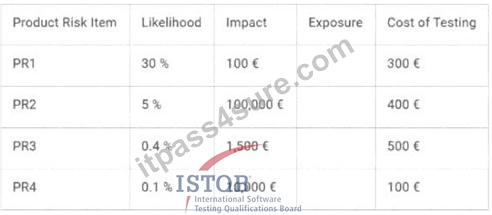
Which of the following statements correctly describes the outcome of the risk assessment using the "Cost of Exposure" technique in this scenario? SELECT ONE OPTION
- A. PR2 should be tested while PR1. PR3 and PR4 should not be tested
- B. Testing for failures associated to PR4 should happen first.
- C. PR1, PR3 and PR4 should be tested while PR2 should not be tested
- D. PR3 and PR4 should be tested while PR! and PR2 should not be tested.
Answer: A
NEW QUESTION # 92
Assume that you are working for a company that has maintained and tested a car parking permit system for many years. The system holds the name and address of permit holders and automatically writes to the permit holder with a form to renew or cancel their permit each year.
The test plan states the following:
"since the system is considered a stable system. Boundary Value Analysis is the only test case design technique that needs to be applied during testing" Consider the following change that was detailed in the Requirements Specification for a replacement to an existing parameter held within the system;
* The specified renewal date for each permit must be not be after 31 st January 2020. Which one of the following is a valid test condition that satisfies both the requirement and the test plan?
SELECT ONE OPTION
- A. Input the dates either side of and including 31/01/2020, and select tests from the regression pack relating to the renewal date and printing only.
- B. Input the date 01/02/2020 and confirm this is not accepted. and select tests from the regression test back relating to the renewal date only
- C. Input the date 01/02/2020 and confirm this is not accepted. and select tests from the regression testback relating to the renewal date only
- D. Input a date in an invalid format e.g. 31 FEB 2020, and select tests from the regression pack relating to renewal date, policy holder's name, address and printing.
- E. Input the date 31/01 /20 in the wrong field to see what happens, and run the whole of the regression test pack.
Answer: A
NEW QUESTION # 93
A test team is working long hours to achieve a deadline for release of a new product which has had problems throughout development and is well behind schedule. Which of the following is most likely to have a MOTIVATING effect on the testers in the team?
SELECT ONE OPTION
- A. A decrease in the scope of testing that the team is responsible for
- B. A planned bonus payment that will be based on customer satisfaction with the product once released.
- C. Testers contributing to ideas for faster defect resolution during regular meetings with the developers.
- D. Routine measurement of outstanding defects during testing.
Answer: C
NEW QUESTION # 94
You are a Test Manager on a new project. The software that is being created will be used to control the projectors in movie theaters. This is a time critical project because the software must be released before the Christmas holiday season which has the highest movie attendance of the year.
You have decided to implement a review process for the work products that are a part of this release to save both time and money. In order to expedite the training, you brought in a consultant to train the participants and moderators in proper review processes. Your team is enthusiastic about participating in the reviews.
The project is in the early planning stages. As the review leader, what is an appropriate activity for you to be doing at this point in the project? [3]
- A. Calculating the ROI for the review process
- B. Setting a minimum number of defects to be identified in each review
- C. Gathering metrics to determine the success of the review process
- D. Selecting the review items and the appropriate review type
Answer: D
NEW QUESTION # 95
What is the main reason why reviews are especially beneficial in the above-mentioned scenario? 2 credits
- A. They find defects early.
- B. They ensure a common understanding of the product.
- C. They can be performed without exercising the code.
- D. They enhance project communication.
Answer: C
NEW QUESTION # 96
One of your team members is struggling to identify the requirements to be tested for a project The requirements documents are not conventional but you have determined that the data is there. If they do some digging to find it Given this information in what competence area does this person need to improve?
- A. Social competence
- B. Personal competence
- C. Professional competence
- D. Methodical competence
Answer: D
Explanation:
Competence in Handling Non-Standard Requirements:
Methodical competence refers to the ability to systematically analyze and interpret information, even when it is unconventional or unstructured.
The tester needs to refine their skills in identifying and deriving testable requirements from the available data.
Evaluation of Options:
A (Professional competence) refers to domain knowledge but does not address the specific challenge.
B is correct as it pertains to systematically working through unconventional requirements.
C (Social competence) and D (Personal competence) do not address the analytical challenge.
Reference and Syllabus Alignment:
Methodical competence is emphasized under "Test Management Skills" in the ISTQB syllabus (TM-3.1.1).
NEW QUESTION # 97
You are Test Manager for a project which is in the Test Implementation stage for the first planned iteration, creation of the initial Test Cases and required test data is progressing well.
The Test Strategy documents the Stakeholders view that small teams should collaborate together to create and test functionality which is to be released in iterations, with each release building on the success of the last.
Stakeholders are willing to accept the risks of a partly working system in the early stages. Delivery of working functionality (particularly around interfaces to third party systems and performance of back end databases) is the priority for the early releases.
Which of the following test types would you select for this first planned iteration, in order to meet Stakeholders expectations?
a) Usability testing
b) Structural testing
c) Functional testing of process flows
d) Performance testing
e) Business process testing
f) Component integration testing
- A. b, c, d and f.
- B. b, d, e and f.
- C. a, c, d and e.
- D. a. b, d and f.
Answer: C
NEW QUESTION # 98
Which of the following Is the common set of information to be produced in a test estimate''
- A. Time per person budget end date start date
- B. Number of people number of systems lines of code, cost
- C. Test effort test duration time to complete, cost
- D. Effort time cost, test activities
Answer: D
Explanation:
* Key Factors in Test Estimation:
* Test estimation requires identifying measurable factors that influence the testing process, includingeffort(workload in person-hours),time(calendar duration),cost, and thespecific test activities(e.g., planning, design, execution).
* These are critical to align resources and schedules, ensuring effective project management.
* Evaluation of Options:
* Ais incorrect: While "lines of code" may relate to testing scope in specific cases, it is not universally applicable in test estimation.
* Bis incorrect: "Start and end dates" are outputs of planning, not estimation.
* Cis partially correct but lacks a focus on "test activities," which is crucial for completeness.
* Dis correct as it covers effort, time, cost, and test activities, reflecting a comprehensive test estimate.
References and Syllabus Alignment:
* As per ISTQB Advanced Test Management syllabus, test estimation should consider effort, time, cost, and activities under "Test Planning" (TM-1.1.1).
NEW QUESTION # 99
You have been asked to make a recommendation on deployment readiness on the software your team has been testing. You have the following metrics: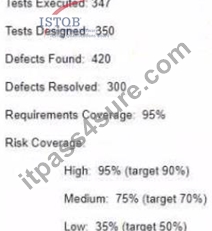
Given this information what is a critical metric you are missing?
- A. Number of defects outstanding
- B. Planned vs actual cost of testing
- C. Residual risk
- D. Number of tests passed
Answer: C
Explanation:
Context Analysis:
Deployment readiness depends on understanding the risk of releasing the software. The metrics provided include execution, design, defect counts, and coverage but do not quantify residual risk, which reflects remaining risks post-testing.
Evaluation of Options:
A . Number of tests passed:
Incorrect. While important, it doesn't directly provide insight into the remaining risk.
B . Number of defects outstanding:
Incorrect. Though critical, it's only one aspect of assessing readiness and doesn't provide the full picture of residual risk.
C . Residual risk:
Correct. Residual risk quantifies untested areas and unresolved issues, vital for decision-making.
D . Planned vs actual cost of testing:
Incorrect. While useful for process evaluation, it's not directly tied to deployment readiness.
Syllabus Alignment:
The syllabus emphasizes risk-based approaches, highlighting residual risk as a critical deployment readiness metric (TM-1.3.4).
Reference:
ISTQB Advanced Level Test Management Syllabus (TM-1.3.4)
NEW QUESTION # 100
While mining the defect database for patterns of problems in the last release, a Test Manager notices that many of the most damaging failures were caused by defects injected during the low-level design phase.
Which of the following actions will likely give this project the most effective solution to this problem? [3]
- A. Increased white-box coverage during system testing
- B. Formal inspections of the code modules affected by the last release
- C. Increased static analysis during the implementation phase
- D. Mandatory reviews of all important design work products
Answer: D
Explanation:
The most effective solution to this problem is to implement mandatory reviews of all important design work products. This is because reviews are a type of static testing technique that can detect and prevent defects early in the software development lifecycle, before they become more costly and difficult to fix. By reviewing the low-level design work products, such as detailed design specifications, the project team can ensure that they are consistent, complete, and correct, and that they meet the requirements and the quality standards. Reviews - ISTQB not-for-profit association Reference: Certified Tester Advanced Level Test Manager (CTAL-TM) - ISTQB not-for-profit association, ISTQB Test Manager Certification - ISTQB Exams Worldwide - ISTQB Official Registration, Reviews - ISTQB not-for-profit association
NEW QUESTION # 101
Your test team is in the process of completing final regression testing one week before the release date. One of your staff has just uncovered a critical defect that causes data corruption.
What should you do? [2]
- A. Update the risks in your test plan to cover data corruption issues and update your test cases to be sure you test for this in the future
- B. Write a high priority defect and follow the escalation communication plan as defined in your test plan
- C. Update the weekly status charts and change the project status to red
- D. Write a high priority defect and call the business stakeholders to warn them about it
Answer: B
Explanation:
The best action that you should take in this situation is to write a high priority defect and follow the escalation communication plan as defined in your test plan. This is because a critical defect that causes data corruption is a serious issue that can affect the quality, functionality, and reliability of the system, and it needs to be reported and resolved as soon as possible. By writing a high priority defect, you can document the details and the impact of the defect, and alert the development team and the project manager about it. By following the escalation communication plan, you can ensure that the defect is communicated to the appropriate stakeholders, such as the business sponsors, the customers, or the senior management, in a timely and effective manner, and that the necessary actions are taken to address the defect. Defect Reporting - ISTQB not-for-profit association References: Certified Tester Advanced Level Test Manager (CTAL-TM) - ISTQB not-for-profit association, ISTQB Test Manager Certification - ISTQB Exams Worldwide - ISTQB Official Registration, Defect Reporting - ISTQB not-for-profit association
NEW QUESTION # 102
Which of the following is a valid drawback of independent testing? 1 credit
- A. Independent testers will become a bottleneck and introduce problems in incident management.
- B. Independent testers need extra education and always cost more.
- C. Developers loose the sense of responsibility and independent testers may become a bottleneck.
- D. Developer and independent testing will overlap and waste resources.
Answer: C
Explanation:
Explanation/Reference:
Explanation:
NEW QUESTION # 103
Test results are reported as "Requirements tested, passed, and failed".
What test strategy are you using? [1]
- A. Analytical
- B. Reactive
- C. Exploratory
- D. Model-based
Answer: A
Explanation:
An analytical test strategy is a test strategy that is based on the analysis of the factors that affect the quality of the software under test, such as the requirements, the risks, the complexity, or the criticality1. An analytical test strategy uses these factors to define the test objectives, scope, approach, and techniques, as well as to prioritize and allocate the test resources2. Reporting the test results as "Requirements tested, passed, and failed" implies that the testing is driven by the requirements, which are the specifications of the desired features and functions of the software under test. Testing based on the requirements is an example of an analytical test strategy, as it uses the requirements as the main factor to guide the testing activities. Therefore, option C is the correct answer. Option A is incorrect because a model-based test strategy is a test strategy that uses models to represent the desired behavior and structure of the software under test, and to derive test cases, test data, test procedures, and test oracles. A model-based test strategy does not necessarily report the test results as "Requirements tested, passed, and failed", as it may use other types of models, such as state diagrams, data flow diagrams, or decision tables, to generate and execute the tests. Option B is incorrect because an exploratory test strategy is a test strategy that uses the tester's knowledge, skills, and creativity to design and execute tests dynamically, without predefined test cases or test procedures. An exploratory test strategy does not report the test results as "Requirements tested, passed, and failed", as it does not follow a formal or structured testing process, but rather relies on the tester's intuition, experience, and feedback.
Option D is incorrect because a reactive test strategy is a test strategy that uses the actual behavior and results of the software under test to design and execute tests, without prior knowledge or documentation of the software. A reactive test strategy does not report the test results as "Requirements tested, passed, and failed", as it does not have any requirements or specifications to compare the software against, but rather uses the software itself as the test basis. References: 1: ISTQB Glossary, Analytical Test Strategy 2: ISTQB Advanced Level Test Manager Syllabus, Section 1.1.1 : ISTQB Glossary, Requirement : ISTQB Advanced Level Test Manager Syllabus, Section 1.1.1 : ISTQB Glossary, Model-Based Testing : ISTQB Advanced Level Test Manager Syllabus, Section 1.1.1 : ISTQB Glossary, Exploratory Testing : ISTQB Advanced Level Test Manager Syllabus, Section 1.1.1 : ISTQB Glossary, Reactive Test Strategy : ISTQB Advanced Level Test Manager Syllabus, Section 1.1.1 : Test Strategy | ISTQB Glossary : Test Strategy - ISTQB not-for-profit association
NEW QUESTION # 104
Which of the following should be considered the biggest risk to the schedule when trying to implement formal scripted test cases early in the SDLC for a system with a large GUI front end?
- A. The developers may feel pressured not to change anything.
- B. The testers will be working on analysis and design early in the schedule.
- C. Test maintenance might be required due to changes in the presentation layer.
- D. Early implementation might uncover errors in the design documentation.
Answer: C
Explanation:
In the context of a system with a large GUI front end, the biggest risk to the schedule when implementing formal scripted test cases early in the SDLC is the potential need for test maintenance due to changes in the presentation layer. This is because the GUI is often subject to change, especially in the early stages of development, as feedback is received and design adjustments are made. These changes can render early test scripts obsolete, requiring updates and maintenance, which can be time-consuming and delay the testing schedule.
References: The answer is supported by the ISTQB Advanced Level Test Manager Syllabus, which emphasizes the importance of considering the volatility of the test object when planning test case design and implementation.
NEW QUESTION # 105
You are working on a project where the business part of the organization works traditionally with defined requirements, but the development team follows an Agile model Neither team plans to change their approach What is the proper name for this type of project approach''
- A. Hybrid as fit for purpose
- B. Agile
- C. Sequential
- D. Hybrid as a transition to Agile
Answer: A
Explanation:
Context Analysis:
The project described has teams using different methodologies (traditional vs. Agile) tailored to their needs.
The "fit for purpose" hybrid approach is explicitly designed to combine methodologies based on team and project requirements.
Evaluation of Options:
A . Sequential:
Incorrect. A sequential approach suggests a traditional waterfall-like model, not a hybrid.
B . Hybrid as a transition to Agile:
Incorrect. This term implies the entire project is transitioning to Agile, which is not the case here.
C . Agile:
Incorrect. Only the development team is Agile; the business team uses a traditional approach.
D . Hybrid as fit for purpose:
Correct. Combines the most effective aspects of both traditional and Agile methodologies to suit the project context.
Syllabus Alignment:
ISTQB defines hybrid models as combinations of methodologies tailored to specific project needs (TM-1.2.4).
Reference:
ISTQB Advanced Level Test Management Syllabus (TM-1.2.4)
NEW QUESTION # 106
Which of the following statements define a test monitoring activity?
- A. Identifying and analyzing new product risks that should be mitigated through test design and execution
- B. Comparing actual progress against the test plan and implementing the necessary corrective actions
- C. Comparing actual results against the expected results as the test cases are executed
- D. Establishing a testing schedule and monitoring framework to enable tracking of the status of testing
Answer: B
Explanation:
According to the ISTQB Advanced Test Manager syllabus,test monitoringinvolvestracking test progressand comparing actual results with planned progress. It helps to identify deviations and allows the Test Manager to take corrective actions.
"Test monitoring involves the ongoing comparison of actual progress against the plan using metrics defined in the test plan" (Source: ISTQB Advanced Level Test Manager Syllabus 2012, Section 1.3.1) Hence,Option Dreflects a test monitoring activity precisely.
NEW QUESTION # 107
What is the purpose of tracking efficiency metrics for a formal review? [1]
- A. These metrics can be used to determine the speed with which defects were fixed.
- B. These metrics can be used to determine the quality of the reviewed object.
- C. These metrics can be used to determine who participated in the review.
- D. These metrics can be used to determine if the review was a good use of resources.
Answer: D
Explanation:
Efficiency metrics for a formal review are used to measure the cost-effectiveness of the review process, such as the time spent on the review, the number of defects found, and the return on investment1. These metrics can help to evaluate if the review was a good use of resources, such as human effort, money, and tools.
Therefore, option B is the correct answer. Option A is incorrect because efficiency metrics do not track who participated in the review, but rather how they performed. Option C is incorrect because efficiency metrics do not measure the quality of the reviewed object, but rather the quality of the review process. Option D is incorrect because efficiency metrics do not measure the speed with which defects were fixed, but rather the speed with which defects were detected. References: 1: How to manage formal reviews & management audits? Skills, metrics ...
NEW QUESTION # 108
What is the purpose of tracking efficiency metrics for a formal review? [1]
- A. These metrics can be used to determine the speed with which defects were fixed.
- B. These metrics can be used to determine the quality of the reviewed object.
- C. These metrics can be used to determine who participated in the review.
- D. These metrics can be used to determine if the review was a good use of resources.
Answer: D
Explanation:
Efficiency metrics for a formal review are used to measure the cost-effectiveness of the review process, such as the time spent on the review, the number of defects found, and the return on investment1. These metrics can help to evaluate if the review was a good use of resources, such as human effort, money, and tools. Therefore, option B is the correct answer. Option A is incorrect because efficiency metrics do not track who participated in the review, but rather how they performed. Option C is incorrect because efficiency metrics do not measure the quality of the reviewed object, but rather the quality of the review process. Option D is incorrect because efficiency metrics do not measure the speed with which defects were fixed, but rather the speed with which defects were detected. References: 1: How to manage formal reviews & management audits? Skills, metrics ...
NEW QUESTION # 109
Which of the following describes the Failure Mode and Effect Analysis (FMEA) risk analysis technique? SELECT ONE OPTION
- A. FMEA is a risk mitigation process that involves determining every possible type of failure, and designing tests to cover each one.
- B. FMEA is an analytical process upstream, that attempts to identify the hazards for each risk.
- C. FMEA is a quality risk management technique concerned with quality risks that arise from an incorrect understanding of the customer requirements.
- D. FMEA is where quality risks, their potential causes and their likely effects are identified and then severity, priority and detection ratings are assigned.
Answer: D
NEW QUESTION # 110
As the Test Manager for an agile project how would you BEST plan and guide the testing activities during development? SELECT ONE OPTION
- A. Ensure testers are integrated into the development process, helping to review and develop automated unit tests
- B. Ensure testers are separated from the developers to provide an independent set of functional tests
- C. Ensure all tests are written and reviewed by the developers to ensure they reflect the code being developed
- D. Ensure testers provide training to developers to help them write a set of auto-mated unit tests
Answer: A
NEW QUESTION # 111
Which of the following are primary activities in conducting product risk analysis? [1]
- A. Risk identification, risk testing
- B. Risk identification, risk assessment
- C. Risk management, risk assessment
- D. Risk testing, risk management
Answer: B
Explanation:
Product risk analysis is the process of identifying and assessing the product risks that may affect the quality or functionality of the software under test1. Product risk analysis involves two primary activities: risk identification and risk assessment. Risk identification is the activity of finding, naming, and describing the risks that might affect the software under test2. Risk assessment is the activity of estimating the impact and probability of occurrence (likelihood) of the identified risks, and prioritizing them based on these factors3. Therefore, option B is the correct answer. Option A is incorrect because risk testing and risk management are not primary activities of product risk analysis, but rather activities that follow or use the results of product risk analysis. Risk testing is the activity of designing, implementing, and executing tests based on the product risk levels to reduce the level of product risks and inform stakeholders of their status4. Risk management is the activity of planning, monitoring, and controlling the risks and the risk mitigation actions in the software project5. Option C is incorrect because risk identification and risk testing are not primary activities of product risk analysis, but rather activities that are part of product risk analysis and risk-based testing respectively. Option D is incorrect because risk management and risk assessment are not primary activities of product risk analysis, but rather activities that are part of risk management and product risk analysis respectively. Reference: 1: ISTQB Glossary, Product Risk Analysis 2: ISTQB Glossary, Risk Identification 3: ISTQB Glossary, Risk Assessment 4: ISTQB Glossary, Risk-Based Testing 5: ISTQB Glossary, Risk Management : Product Risk Analysis (PRA) | TMap : Risk-Based Testing | ISTQB Glossary : Risk Analysis | ISTQB Glossary
NEW QUESTION # 112
......
Difficulty in writing the CTAL-TM Exam
As all people know about this fact that CTAL-TM exam is not easy to pass because it requires a lot of efforts and a dependable and latest study material to efficiently pass the exam. Many Candidates have doubts in their mind before writing the Cisco Understanding CTAL-TM certification exam that is a pattern of the test, the types of questions asked in it and the difficulty level of the questions and time required to complete the questions. The best way to pass CTAL-TM exam is to challenge and improve knowledge. Candidates test their learning and identify improvement areas with actual exam format. The best solution is to practice with CTAL-TM Certification Practice Exam because the practice test is one of the most important elements of CTAL-TM exam study strategy in which Candidates can discover their strengths and weaknesses to improve time management skills and to get an idea of the score that they can expect. itPass4sure offers the latest exam questions for the CTAL-TM Exam which can be understood by the candidates deprived of any difficulty. Our 210-250 exam dumps study material is best-suited to busy professionals who don't have much to spend on preparation and want to pass it in a week. Our CTAL-TM practice exam has been duly prepared by the team of experts after an in-depth analysis of Cisco recommended syllabus. We update our material regularly. So, it is intended to keep candidates updated because as and when Cisco will announce any changes in the material; we will update the material right away. After practicing with our CTAL-TM exam dumps Candidate can pass CTAL-TM exam with good grades.
Latest CTAL_TM_001 Exam Dumps ISTQB Exam: https://www.itpass4sure.com/CTAL_TM_001-practice-exam.html
Pass ISTQB CTAL_TM_001 PDF Dumps Recently Updated 232 Questions: https://drive.google.com/open?id=1Hll-XLqIskXSXgTwM6zcrYsvEZaTlCEY
