

Databricks-Generative-AI-Engineer-Associate PDF Dumps Jul 03, 2026 Exam Questions – Valid Databricks-Generative-AI-Engineer-Associate Dumps
Ultimate Databricks-Generative-AI-Engineer-Associate Guide to Prepare Free Latest Databricks Practice Tests Dumps
NEW QUESTION # 37
A team uses Mosaic AI Vector Search to retrieve documents for their Retrieval-Augmented Generation (RAG) pipeline. The search query returns five relevant documents, and the first three are added to the prompt as context. Performance evaluation with Agent Evaluation shows that some lower-ranked retrieved documents have higher context relevancy scores than higher-ranked documents. Which option should the team consider to optimize this workflow?
- A. Use a different embedding model for computing document embeddings.
- B. Modify the prompt to instruct the LLM to order the documents based on the relevance scores.
- C. Use a reranker to order the documents based on the relevance scores.
- D. Increase the number of documents added to the prompt to improve context relevance.
Answer: C
Explanation:
The scenario describes a common "retrieval gap" where the initial bi-encoder (embedding model) used for vector search identifies relevant documents but does not rank them perfectly. This happens because embedding models represent entire documents as a single vector, which can lose nuance. The standard engineering solution is to implement a Reranker (Cross-Encoder). Unlike embedding models, a reranker processes the query and a candidate document simultaneously, allowing it to capture deep semantic interactions between the two. In a Mosaic AI workflow, after the vector search retrieves the top $k$ documents, the reranker evaluates those specific $k$ documents to produce a more accurate relevance score. This ensures that the most contextually relevant documents are placed at the top of the list (and thus the top of the LLM prompt), which is crucial because LLMs are sensitive to document order and often prioritize information found at the beginning of the context.
NEW QUESTION # 38
A Generative Al Engineer is creating an LLM-based application. The documents for its retriever have been chunked to a maximum of 512 tokens each. The Generative Al Engineer knows that cost and latency are more important than quality for this application. They have several context length levels to choose from.
Which will fulfill their need?
- A. context length 32768: smallest model is 14GB and embedding dimension 4096
- B. context length 2048: smallest model is 11GB and embedding dimension 2560
- C. context length 512: smallest model is 0.13GB and embedding dimension 384
- D. context length 514; smallest model is 0.44GB and embedding dimension 768
Answer: C
Explanation:
When prioritizing cost and latency over quality in a Large Language Model (LLM)-based application, it is crucial to select a configuration that minimizes both computational resources and latency while still providing reasonable performance. Here's why D is the best choice:
Context length: The context length of 512 tokens aligns with the chunk size used for the documents (maximum of 512 tokens per chunk). This is sufficient for capturing the needed information and generating responses without unnecessary overhead.
Smallest model size: The model with a size of 0.13GB is significantly smaller than the other options. This small footprint ensures faster inference times and lower memory usage, which directly reduces both latency and cost.
Embedding dimension: While the embedding dimension of 384 is smaller than the other options, it is still adequate for tasks where cost and speed are more important than precision and depth of understanding.
This setup achieves the desired balance between cost-efficiency and reasonable performance in a latency-sensitive, cost-conscious application.
NEW QUESTION # 39
A Generative AI Engineer I using the code below to test setting up a vector store: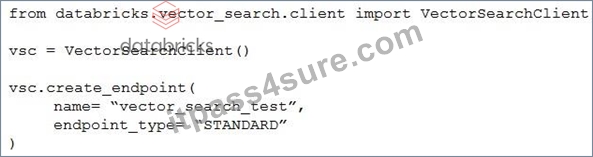
Assuming they intend to use Databricks managed embeddings with the default embedding model, what should be the next logical function call?
- A. vsc.similarity_search()
- B. vsc.get_index()
- C. vsc.create_direct_access_index()
- D. vsc.create_delta_sync_index()
Answer: D
Explanation:
* Context: The Generative AI Engineer is setting up a vector store using Databricks' VectorSearchClient. This is typically done to enable fast and efficient retrieval of vectorized data for tasks like similarity searches.
* Explanation of Options:
Option A: vsc.get_index(): This function would be used to retrieve an existing index, not create one, so it would not be the logical next step immediately after creating an endpoint.
Option B: vsc.create_delta_sync_index(): After setting up a vector store endpoint, creating an index is necessary to start populating and organizing the data. The create_delta_sync_index() function specifically creates an index that synchronizes with a Delta table, allowing automatic updates as the data changes. This is likely the most appropriate choice if the engineer plans to use dynamic data that is updated over time.
Option C: vsc.create_direct_access_index(): This function would create an index that directly accesses the data without synchronization. While also a valid approach, it's less likely to be the next logical step if the default setup (typically accommodating changes) is intended.
Option D: vsc.similarity_search(): This function would be used to perform searches on an existing index; however, an index needs to be created and populated with data before any search can be conducted.
Given the typical workflow in setting up a vector store, the next step after creating an endpoint is to establish an index, particularly one that synchronizes with ongoing data updates, hence Option B.
NEW QUESTION # 40
A Generative Al Engineer has already trained an LLM on Databricks and it is now ready to be deployed.
Which of the following steps correctly outlines the easiest process for deploying a model on Databricks?
- A. Save the model along with its dependencies in a local directory, build the Docker image, and run the Docker container
- B. Wrap the LLM's prediction function into a Flask application and serve using Gunicorn
- C. Log the model using MLflow during training, directly register the model to Unity Catalog using the MLflow API, and start a serving endpoint
- D. Log the model as a pickle object, upload the object to Unity Catalog Volume, register it to Unity Catalog using MLflow, and start a serving endpoint
Answer: C
NEW QUESTION # 41
A Generative Al Engineer is setting up a Databricks Vector Search that will lookup news articles by topic within 10 days of the date specified An example query might be "Tell me about monster truck news around January 5th 1992". They want to do this with the least amount of effort.
How can they set up their Vector Search index to support this use case?
- A. Split articles by 10 day blocks and return the block closest to the query.
- B. Create separate indexes by topic and add a classifier model to appropriately pick the best index.
- C. Include metadata columns for article date and topic to support metadata filtering.
- D. pass the query directly to the vector search index and return the best articles.
Answer: C
Explanation:
The task is to set up a Databricks Vector Search index for news articles, supporting queries like "monster truck news around January 5th, 1992," with minimal effort. The index must filter by topic and a 10-day date range. Let's evaluate the options.
* Option A: Split articles by 10-day blocks and return the block closest to the query
* Pre-splitting articles into 10-day blocks requires significant preprocessing and index management (e.g., one index per block). It's effort-intensive and inflexible for dynamic date ranges.
* Databricks Reference:"Static partitioning increases setup complexity; metadata filtering is preferred"("Databricks Vector Search Documentation").
* Option B: Include metadata columns for article date and topic to support metadata filtering
* Adding date and topic as metadata in the Vector Search index allows dynamic filtering (e.g., date
± 5 days, topic = "monster truck") at query time. This leverages Databricks' built-in metadata filtering, minimizing setup effort.
* Databricks Reference:"Vector Search supports metadata filtering on columns like date or category for precise retrieval with minimal preprocessing"("Vector Search Guide," 2023).
* Option C: Pass the query directly to the vector search index and return the best articles
* Passing the full query (e.g., "Tell me about monster truck news around January 5th, 1992") to Vector Search relies solely on embeddings, ignoring structured filtering for date and topic. This risks inaccurate results without explicit range logic.
* Databricks Reference:"Pure vector similarity may not handle temporal or categorical constraints effectively"("Building LLM Applications with Databricks").
* Option D: Create separate indexes by topic and add a classifier model to appropriately pick the best index
* Separate indexes per topic plus a classifier model adds significant complexity (index creation, model training, maintenance), far exceeding "least effort." It's overkill for this use case.
* Databricks Reference:"Multiple indexes increase overhead; single-index with metadata is simpler"("Databricks Vector Search Documentation").
Conclusion: Option B is the simplest and most effective solution, using metadata filtering in a single Vector Search index to handle date ranges and topics, aligning with Databricks' emphasis on efficient, low-effort setups.
NEW QUESTION # 42
A Generative Al Engineer is building an LLM-based application that has an important transcription (speech-to-text) task. Speed is essential for the success of the application Which open Generative Al models should be used?
- A. MPT-30B-lnstruct
- B. whisper-large-v3 (1.6B)
- C. DBRX
- D. L!ama-2-70b-chat-hf
Answer: B
Explanation:
The task requires an open generative AI model for a transcription (speech-to-text) task where speed is essential. Let's assess the options based on their suitability for transcription and performance characteristics, referencing Databricks' approach to model selection.
Option A: Llama-2-70b-chat-hf
Llama-2 is a text-based LLM optimized for chat and text generation, not speech-to-text. It lacks transcription capabilities.
Databricks Reference: "Llama models are designed for natural language generation, not audio processing" ("Databricks Model Catalog").
Option B: MPT-30B-Instruct
MPT-30B is another text-based LLM focused on instruction-following and text generation, not transcription. It's irrelevant for speech-to-text tasks.
Databricks Reference: No specific mention, but MPT is categorized under text LLMs in Databricks' ecosystem, not audio models.
Option C: DBRX
DBRX, developed by Databricks, is a powerful text-based LLM for general-purpose generation. It doesn't natively support speech-to-text and isn't optimized for transcription.
Databricks Reference: "DBRX excels at text generation and reasoning tasks" ("Introducing DBRX," 2023)-no mention of audio capabilities.
Option D: whisper-large-v3 (1.6B)
Whisper, developed by OpenAI, is an open-source model specifically designed for speech-to-text transcription. The "large-v3" variant (1.6 billion parameters) balances accuracy and efficiency, with optimizations for speed via quantization or deployment on GPUs-key for the application's requirements.
Databricks Reference: "For audio transcription, models like Whisper are recommended for their speed and accuracy" ("Generative AI Cookbook," 2023). Databricks supports Whisper integration in its MLflow or Lakehouse workflows.
Conclusion: Only D. whisper-large-v3 is a speech-to-text model, making it the sole suitable choice. Its design prioritizes transcription, and its efficiency (e.g., via optimized inference) meets the speed requirement, aligning with Databricks' model deployment best practices.
NEW QUESTION # 43
A Generative AI Engineer is developing an LLM application that users can use to generate personalized birthday poems based on their names.
Which technique would be most effective in safeguarding the application, given the potential for malicious user inputs?
- A. Reduce the time that the users can interact with the LLM
- B. Implement a safety filter that detects any harmful inputs and ask the LLM to respond that it is unable to assist
- C. Ask the LLM to remind the user that the input is malicious but continue the conversation with the user
- D. Increase the amount of compute that powers the LLM to process input faster
Answer: B
Explanation:
In this case, the Generative AI Engineer is developing an application to generate personalized birthday poems, but there's a need to safeguard against malicious user inputs. The best solution is to implement a safety filter (option A) to detect harmful or inappropriate inputs.
Safety Filter Implementation:
Safety filters are essential for screening user input and preventing inappropriate content from being processed by the LLM. These filters can scan inputs for harmful language, offensive terms, or malicious content and intervene before the prompt is passed to the LLM.
Graceful Handling of Harmful Inputs:
Once the safety filter detects harmful content, the system can provide a message to the user, such as "I'm unable to assist with this request," instead of processing or responding to malicious input. This protects the system from generating harmful content and ensures a controlled interaction environment.
Why Other Options Are Less Suitable:
B (Reduce Interaction Time): Reducing the interaction time won't prevent malicious inputs from being entered.
C (Continue the Conversation): While it's possible to acknowledge malicious input, it is not safe to continue the conversation with harmful content. This could lead to legal or reputational risks.
D (Increase Compute Power): Adding more compute doesn't address the issue of harmful content and would only speed up processing without resolving safety concerns.
Therefore, implementing a safety filter that blocks harmful inputs is the most effective technique for safeguarding the application.
NEW QUESTION # 44
When developing an LLM application, it's crucial to ensure that the data used for training the model complies with licensing requirements to avoid legal risks.
Which action is NOT appropriate to avoid legal risks?
- A. Use any available data you personally created which is completely original and you can decide what license to use.
- B. Only use data explicitly labeled with an open license and ensure the license terms are followed.
- C. Reach out to the data curators directly after you have started using the trained model to let them know.
- D. Reach out to the data curators directly before you have started using the trained model to let them know.
Answer: C
Explanation:
* Problem Context: When using data to train a model, it's essential to ensure compliance with licensing to avoid legal risks. Legal issues can arise from using data without permission, especially when it comes from third-party sources.
* Explanation of Options:
* Option A: Reaching out to data curatorsbeforeusing the data is an appropriate action. This allows you to ensure you have permission or understand the licensing terms before starting to use the data in your model.
* Option B: Usingoriginal datathat you personally created is always a safe option. Since you have full ownership over the data, there are no legal risks, as you control the licensing.
* Option C: Using data that is explicitly labeled with an open license and adhering to the license terms is a correct and recommended approach. This ensures compliance with legal requirements.
* Option D: Reaching out to the data curatorsafteryou have already started using the trained model isnot appropriate. If you've already used the data without understanding its licensing terms, you may have already violated the terms of use, which could lead to legal complications. It's essential to clarify the licensing termsbeforeusing the data, not after.
Thus,Option Dis not appropriate because it could expose you to legal risks by using the data without first obtaining the proper licensing permissions.
NEW QUESTION # 45
A Generative Al Engineer is deciding between using LSH (Locality Sensitive Hashing) and HNSW (Hierarchical Navigable Small World) for indexing their vector database Their top priority is semantic accuracy Which approach should the Generative Al Engineer use to evaluate these two techniques?
- A. Compare the cosine similarities of the embeddings of returned results against those of a representative sample of test inputs
- B. Compare the Levenshtein distances of returned results against a representative sample of test inputs
- C. Compare the Bilingual Evaluation Understudy (BLEU) scores of returned results for a representative sample of test inputs
- D. Compare the Recall-Onented-Understudy for Gistmg Evaluation (ROUGE) scores of returned results for a representative sample of test inputs
Answer: A
Explanation:
The task is to choose between LSH and HNSW for a vector database index, prioritizing semantic accuracy. The evaluation must assess how well each method retrieves semantically relevant results. Let's evaluate the options.
Option A: Compare the cosine similarities of the embeddings of returned results against those of a representative sample of test inputs Cosine similarity measures semantic closeness between vectors, directly assessing retrieval accuracy in a vector database. Comparing returned results' embeddings to test inputs' embeddings evaluates how well LSH or HNSW preserves semantic relationships, aligning with the priority.
Databricks Reference: "Cosine similarity is a standard metric for evaluating vector search accuracy" ("Databricks Vector Search Documentation," 2023).
Option B: Compare the Bilingual Evaluation Understudy (BLEU) scores of returned results for a representative sample of test inputs BLEU evaluates text generation (e.g., translations), not vector retrieval accuracy. It's irrelevant for indexing performance.
Databricks Reference: "BLEU applies to generative tasks, not retrieval" ("Generative AI Cookbook").
Option C: Compare the Recall-Oriented-Understudy for Gisting Evaluation (ROUGE) scores of returned results for a representative sample of test inputs ROUGE is for summarization evaluation, not vector search. It doesn't measure semantic accuracy in retrieval.
Databricks Reference: "ROUGE is unsuited for vector database evaluation" ("Building LLM Applications with Databricks").
Option D: Compare the Levenshtein distances of returned results against a representative sample of test inputs Levenshtein distance measures string edit distance, not semantic similarity in embeddings. It's inappropriate for vector-based retrieval.
Databricks Reference: No specific support for Levenshtein in vector search contexts.
Conclusion: Option A (cosine similarity) is the correct approach, directly evaluating semantic accuracy in vector retrieval, as recommended by Databricks for Vector Search assessments.
NEW QUESTION # 46
A team wants to serve a code generation model as an assistant for their software developers. It should support multiple programming languages. Quality is the primary objective.
Which of the Databricks Foundation Model APIs, or models available in the Marketplace, would be the best fit?
- A. BGE-large
- B. Llama2-70b
- C. MPT-7b
- D. CodeLlama-34B
Answer: D
Explanation:
For a code generation model that supports multiple programming languages and where quality is the primary objective,CodeLlama-34Bis the most suitable choice. Here's the reasoning:
* Specialization in Code Generation:CodeLlama-34B is specifically designed for code generation tasks.
This model has been trained with a focus on understanding and generating code, which makes it particularly adept at handling various programming languages and coding contexts.
* Capacity and Performance:The "34B" indicates a model size of 34 billion parameters, suggesting a high capacity for handling complex tasks and generating high-quality outputs. The large model size typically correlates with better understanding and generation capabilities in diverse scenarios.
* Suitability for Development Teams:Given that the model is optimized for code, it will be able to assist software developers more effectively than general-purpose models. It understands coding syntax, semantics, and the nuances of different programming languages.
* Why Other Options Are Less Suitable:
* A (Llama2-70b): While also a large model, it's more general-purpose and may not be as fine- tuned for code generation as CodeLlama.
* B (BGE-large): This model may not specifically focus on code generation.
* C (MPT-7b): Smaller than CodeLlama-34B and likely less capable in handling complex code generation tasks at high quality.
Therefore, for a high-quality, multi-language code generation application,CodeLlama-34B(option D) is the best fit.
NEW QUESTION # 47
A Generative AI Engineer at an automotive company would like to build a question-answering chatbot to help customers answer specific questions about their vehicles. They have:
A catalog with hundreds of thousands of cars manufactured since the 1960s Historical searches with user queries and successful matches Descriptions of their own cars in multiple languages They have already selected an open-source LLM and created a test set of user queries. They need to discard techniques that will not help them build the chatbot. Which do they discard?
- A. Implementing metadata filtering based on car models and years
- B. Adding few-shot examples for response generation
- C. Fine-tuning an embedding model on automotive terminology
- D. Setting chunk size to match the model's context window to maximize coverage
Answer: D
Explanation:
According to Generative AI engineering standards for Retrieval-Augmented Generation (RAG), chunking strategy is a critical optimization variable. Setting the chunk size to match the model's maximum context window (e.g., 4k or 8k tokens) is a poor practice and should be discarded. Large chunks introduce significant "noise" into the LLM's context, as only a small portion of a massive chunk usually contains the answer to a specific query. This leads to the "lost in the middle" phenomenon where LLMs struggle to extract relevant information from bloated contexts. Furthermore, large chunks reduce the precision of the vector search. Standard best practices involve using smaller, semantically meaningful chunks (typically 256-512 tokens) with overlap to maintain context. In contrast, metadata filtering (B) is essential for narrowing searches to specific car years, fine-tuning embeddings (C) improves retrieval accuracy for domain-specific technical terms, and few-shot examples (D) guide the LLM's output format and tone.
NEW QUESTION # 48
A Generative AI Engineer at a legal firm is designing a RAG system to analyze historical legal cases. The system needs to process millions of court opinions and legal documents, already organized by time and topic, to track how interpretations of specific laws have evolved over time. All of these documents are in plain-text. The engineer needs to choose a chunking method that would most effectively preserve continuity and the temporal nature of the cases. Which method do they choose?
- A. Implement a hierarchical tree structure, like RAPTOR, to group similar legal concepts.
- B. Implement paragraph level embeddings with each chunk.
- C. Implement windowed summarization with overlapping chunks.
- D. Implement sentence level embeddings with each chunk tagged with the time to enable metadata filtering.
Answer: C
Explanation:
In the context of legal document analysis where the "evolution of interpretation" is the primary goal, preserving narrative continuity is paramount. Windowed summarization with overlapping chunks is the most effective method for this use case. Overlapping (e.g., 10-15% of the chunk size) ensures that sentences or concepts split at the boundary of one chunk are preserved in the next, preventing the loss of critical context that often occurs in legal jargon. Furthermore, windowed summarization allows the system to condense long-form court opinions into manageable parts while maintaining the chronological "thread" of the argument. While sentence-level embeddings with metadata (D) are useful for filtering, they often lack the sufficient context required to understand the nuances of a legal ruling. A windowed approach provides the LLM with enough surrounding text to understand the "why" behind a legal evolution, rather than just the "when."
NEW QUESTION # 49
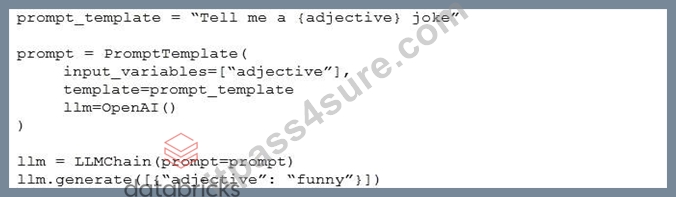
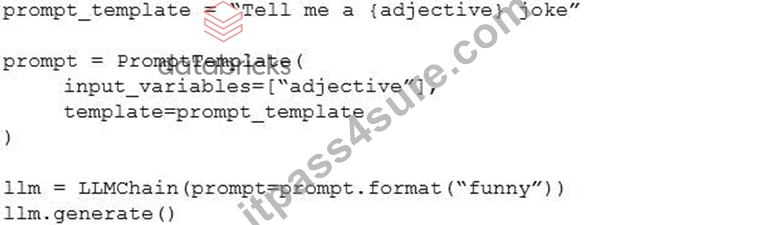
A Generative AI Engineer is testing a simple prompt template in LangChain using the code below, but is getting an error.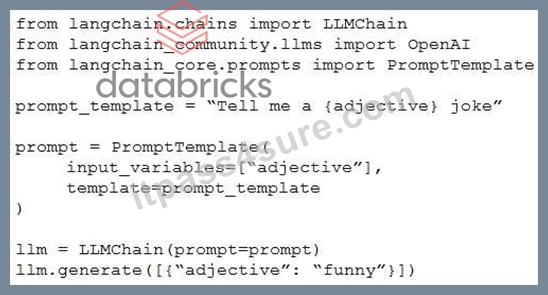
Assuming the API key was properly defined, what change does the Generative AI Engineer need to make to fix their chain?
- A.
- B.
- C.
- D.
Answer: C
Explanation:
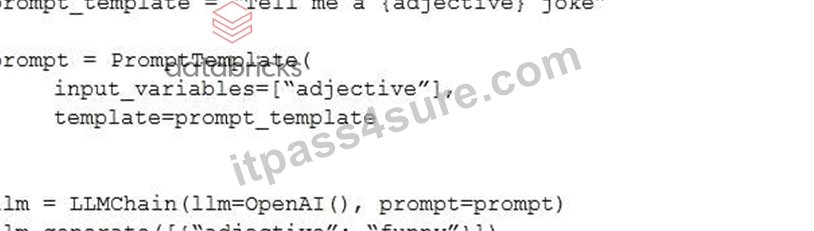
To fix the error in the LangChain code provided for using a simple prompt template, the correct approach is Option C. Here's a detailed breakdown of why Option C is the right choice and how it addresses the issue:
* Proper Initialization: In Option C, the LLMChain is correctly initialized with the LLM instance specified as OpenAI(), which likely represents a language model (like GPT) from OpenAI. This is crucial as it specifies which model to use for generating responses.
* Correct Use of Classes and Methods:
* The PromptTemplate is defined with the correct format, specifying that adjective is a variable within the template. This allows dynamic insertion of values into the template when generating text.
* The prompt variable is properly linked with the PromptTemplate, and the final template string is passed correctly.
* The LLMChain correctly references the prompt and the initialized OpenAI() instance, ensuring that the template and the model are properly linked for generating output.
Why Other Options Are Incorrect:
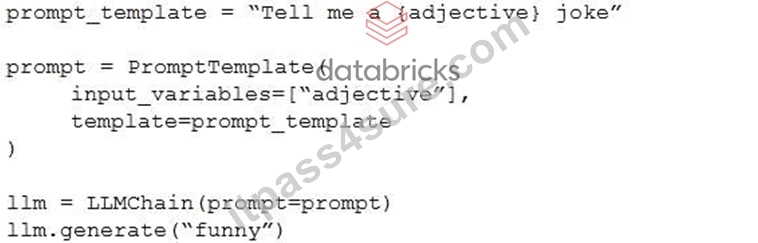
* Option A: Misuses the parameter passing in generate method by incorrectly structuring the dictionary.
* Option B: Incorrectly uses prompt.format method which does not exist in the context of LLMChain and PromptTemplate configuration, resulting in potential errors.
* Option D: Incorrect order and setup in the initialization parameters for LLMChain, which would likely lead to a failure in recognizing the correct configuration for prompt and LLM usage.
Thus, Option C is correct because it ensures that the LangChain components are correctly set up and integrated, adhering to proper syntax and logical flow required by LangChain's architecture. This setup avoids common pitfalls such as type errors or method misuses, which are evident in other options.
NEW QUESTION # 50
A Generative AI Engineer is creating an agent-based LLM system for their favorite monster truck team. The system can answer text based questions about the monster truck team, lookup event dates via an API call, or query tables on the team's latest standings.
How could the Generative AI Engineer best design these capabilities into their system?
- A. Write a system prompt for the agent listing available tools and bundle it into an agent system that runs a number of calls to solve a query.
- B. Instruct the LLM to respond with "RAG", "API", or "TABLE" depending on the query, then use text parsing and conditional statements to resolve the query.
- C. Build a system prompt with all possible event dates and table information in the system prompt. Use a RAG architecture to lookup generic text questions and otherwise leverage the information in the system prompt.
- D. Ingest PDF documents about the monster truck team into a vector store and query it in a RAG architecture.
Answer: A
Explanation:
In this scenario, the Generative AI Engineer needs to design a system that can handle different types of queries about the monster truck team. The queries may involve text-based information, API lookups for event dates, or table queries for standings. The best solution is to implement a tool-based agent system.
Here's how option B works, and why it's the most appropriate answer:
System Design Using Agent-Based Model:
In modern agent-based LLM systems, you can design a system where the LLM (Large Language Model) acts as a central orchestrator. The model can "decide" which tools to use based on the query. These tools can include API calls, table lookups, or natural language searches. The system should contain a system prompt that informs the LLM about the available tools.
System Prompt Listing Tools:
By creating a well-crafted system prompt, the LLM knows which tools are at its disposal. For instance, one tool may query an external API for event dates, another might look up standings in a database, and a third may involve searching a vector database for general text-based information. The agent will be responsible for calling the appropriate tool depending on the query.
Agent Orchestration of Calls:
The agent system is designed to execute a series of steps based on the incoming query. If a user asks for the next event date, the system will recognize this as a task that requires an API call. If the user asks about standings, the agent might query the appropriate table in the database. For text-based questions, it may call a search function over ingested data. The agent orchestrates this entire process, ensuring the LLM makes calls to the right resources dynamically.
Generative AI Tools and Context:
This is a standard architecture for integrating multiple functionalities into a system where each query requires different actions. The core design in option B is efficient because it keeps the system modular and dynamic by leveraging tools rather than overloading the LLM with static information in a system prompt (like option D).
Why Other Options Are Less Suitable:
A (RAG Architecture): While relevant, simply ingesting PDFs into a vector store only helps with text-based retrieval. It wouldn't help with API lookups or table queries.
C (Conditional Logic with RAG/API/TABLE): Although this approach works, it relies heavily on manual text parsing and might introduce complexity when scaling the system.
D (System Prompt with Event Dates and Standings): Hardcoding dates and table information into a system prompt isn't scalable. As the standings or events change, the system would need constant updating, making it inefficient.
By bundling multiple tools into a single agent-based system (as in option B), the Generative AI Engineer can best handle the diverse requirements of this system.
NEW QUESTION # 51
A Generative Al Engineer has already trained an LLM on Databricks and it is now ready to be deployed.
Which of the following steps correctly outlines the easiest process for deploying a model on Databricks?
- A. Save the model along with its dependencies in a local directory, build the Docker image, and run the Docker container
- B. Wrap the LLM's prediction function into a Flask application and serve using Gunicorn
- C. Log the model using MLflow during training, directly register the model to Unity Catalog using the MLflow API, and start a serving endpoint
- D. Log the model as a pickle object, upload the object to Unity Catalog Volume, register it to Unity Catalog using MLflow, and start a serving endpoint
Answer: C
Explanation:
* Problem Context: The goal is to deploy a trained LLM on Databricks in the simplest and most integrated manner.
* Explanation of Options:
* Option A: This method involves unnecessary steps like logging the model as a pickle object, which is not the most efficient path in a Databricks environment.
* Option B: Logging the model with MLflow during training and then using MLflow's API to register and start serving the model is straightforward and leverages Databricks' built-in functionalities for seamless model deployment.
* Option C: Building and running a Docker container is a complex and less integrated approach within the Databricks ecosystem.
* Option D: Using Flask and Gunicorn is a more manual approach and less integrated compared to the native capabilities of Databricks and MLflow.
OptionBprovides the most straightforward and efficient process, utilizing Databricks' ecosystem to its full advantage for deploying models.
NEW QUESTION # 52
A Generative AI Engineer is building a Generative AI system that suggests the best matched employee team member to newly scoped projects. The team member is selected from a very large team. Thematch should be based upon project date availability and how well their employee profile matches the project scope. Both the employee profile and project scope are unstructured text.
How should the Generative Al Engineer architect their system?
- A. Create a tool to find available team members given project dates. Create a second tool that can calculate a similarity score for a combination of team member profile and the project scope. Iterate through the team members and rank by best score to select a team member.
- B. Create a tool for finding team member availability given project dates, and another tool that uses an LLM to extract keywords from project scopes. Iterate through available team members' profiles and perform keyword matching to find the best available team member.
- C. Create a tool for finding available team members given project dates. Embed all project scopes into a vector store, perform a retrieval using team member profiles to find the best team member.
- D. Create a tool for finding available team members given project dates. Embed team profiles into a vector store and use the project scope and filtering to perform retrieval to find the available best matched team members.
Answer: D
Explanation:
* Problem Context: The problem involves matching team members to new projects based on two main factors:
* Availability: Ensure the team members are available during the project dates.
* Profile-Project Match: Use the employee profiles (unstructured text) to find the best match for a project's scope (also unstructured text).
The two main inputs are theemployee profilesandproject scopes, both of which are unstructured. This means traditional rule-based systems (e.g., simple keyword matching) would be inefficient, especially when working with large datasets.
* Explanation of Options: Let's break down the provided options to understand why D is the most optimal answer.
* Option Asuggests embedding project scopes into a vector store and then performing retrieval using team member profiles. While embedding project scopes into a vector store is a valid technique, it skips an important detail: the focus should primarily be on embedding employee profiles because we're matching the profiles to a new project, not the other way around.
* Option Binvolves using a large language model (LLM) to extract keywords from the project scope and perform keyword matching on employee profiles. While LLMs can help with keyword extraction, this approach is too simplistic and doesn't leverage advanced retrieval techniques like vector embeddings, which can handle the nuanced and rich semantics of unstructured data. This approach may miss out on subtle but important similarities.
* Option Csuggests calculating a similarity score between each team member's profile and project scope. While this is a good idea, it doesn't specify how to handle the unstructured nature of data efficiently. Iterating through each member's profile individually could be computationally expensive in large teams. It also lacks the mention of using a vector store or an efficient retrieval mechanism.
* Option Dis the correct approach. Here's why:
* Embedding team profiles into a vector store: Using a vector store allows for efficient similarity searches on unstructured data. Embedding the team member profiles into vectors captures their semantics in a way that is far more flexible than keyword-based matching.
* Using project scope for retrieval: Instead of matching keywords, this approach suggests using vector embeddings and similarity search algorithms (e.g., cosine similarity) to find the team members whose profiles most closely align with the project scope.
* Filtering based on availability: Once the best-matched candidates are retrieved based on profile similarity, filtering them by availability ensures that the system provides a practically useful result.
This method efficiently handles large-scale datasets by leveragingvector embeddingsandsimilarity search techniques, both of which are fundamental tools inGenerative AI engineeringfor handling unstructured text.
* Technical References:
* Vector embeddings: In this approach, the unstructured text (employee profiles and project scopes) is converted into high-dimensional vectors using pretrained models (e.g., BERT, Sentence-BERT, or custom embeddings). These embeddings capture the semantic meaning of the text, making it easier to perform similarity-based retrieval.
* Vector stores: Solutions likeFAISSorMilvusallow storing and retrieving large numbers of vector embeddings quickly. This is critical when working with large teams where querying through individual profiles sequentially would be inefficient.
* LLM Integration: Large language models can assist in generating embeddings for both employee profiles and project scopes. They can also assist in fine-tuning similarity measures, ensuring that the retrieval system captures the nuances of the text data.
* Filtering: After retrieving the most similar profiles based on the project scope, filtering based on availability ensures that only team members who are free for the project are considered.
This system is scalable, efficient, and makes use of the latest techniques inGenerative AI, such as vector embeddings and semantic search.
NEW QUESTION # 53
A Generative AI Engineer is using LangGraph to define multiple tools in a single agentic application. They want to enable the main orchestrator LLM to decide on its own which tools are most appropriate to call for a given prompt. To do this, they must determine the general flow of the code. Which sequence will do this?
- A. 1. Define the tools 2. Load each tool into a separate agent 3. Instruct the LLM to use ReAct to call the appropriate agent
- B. 1. Define or import the tools 2. Add tools and LLM to the agent 3. Create the ReAct agent
- C. 1. Define the tools inside the agents 2. Load the agents into the LLM 3. Instruct the LLM to use COT reasoning to determine the appropriate agent
- D. 1. Define or import the tools 2. Define the agent 3. Initialize the agent with ReAct, the LLM, and the tools
Answer: D
Explanation:
In modern agentic frameworks like LangGraph or LangChain, the standard workflow for creating an autonomous tool-calling agent follows a specific sequence. First, tools must be defined (often as Python functions with clear docstrings, which the LLM uses to understand the tool's purpose). Second, the agent logic is defined, which specifies how the LLM should think. Third, the agent is initialized using a logic pattern like ReAct (Reason + Act). The ReAct framework is essential here because it enables the "orchestrator" loop: the LLM receives a prompt, generates a "Thought" about which tool to use, generates an "Action" to call that tool, receives an "Observation" (the tool's output), and repeats until it can provide a final answer. Loading tools into "separate agents" (C) or defining tools "inside" agents (D) are non-standard patterns that add unnecessary complexity and do not align with the centralized orchestration model required for LangGraph.
NEW QUESTION # 54
......
Passing Key To Getting Databricks-Generative-AI-Engineer-Associate Certified Exam Engine PDF: https://www.itpass4sure.com/Databricks-Generative-AI-Engineer-Associate-practice-exam.html
Get Top-Rated Databricks Databricks-Generative-AI-Engineer-Associate Exam Dumps Now: https://drive.google.com/open?id=10KOlJLLQhkQJVTSuL3Rb8WzzKds1R0bF
